Still Going Home
A Real-World Story of Homecare After a Life-Changing Stroke
How NurseLink Healthcare Supported A Family Through Stroke Recovery At Home
Introduction
A stroke arrives without warning. One moment, a person is living their ordinary life – getting dressed, making breakfast, talking with someone they love. And then, in the space of minutes, everything changes. Not just for the person it happens to, but for every member of the family gathered around the hospital bed in the days that follow, trying to understand what recovery might look like and whether home is still a realistic destination.
For many stroke survivors in Australia, the road between hospital discharge and a return to meaningful daily living is longer, harder and lonelier than anyone anticipates. The medical team does what it can within the limits of an acute care setting. And then the family takes over, often without the clinical knowledge, the physical capacity or the emotional reserves to do so safely or sustainably.
Homecare, when it is thoughtfully designed and genuinely delivered, can change that equation entirely. It can be the thing that makes recovery at home not just possible, but purposeful – turning what might otherwise be a frightening and isolating experience into one where progress, however gradual, is genuinely felt.
At NurseLink Healthcare, our homecare services are built on the belief that recovery belongs at home whenever it safely can. This case study documents how our team supported a stroke survivor in Brisbane, Queensland, and his family through four to six months of intensive home-based rehabilitation support, at a point when the alternative was a long-term care facility.
To protect the privacy of the client and his family, all names and identifying details have been kept confidential throughout this case study.
The Client & His Situation
The client is a man in his late sixties who had lived an active and largely independent life in Brisbane’s inner south. He had retired from a long career in logistics management several years prior, and retirement had been good to him. He gardened, he cooked, he walked regularly with his wife of more than forty years, and he was a fixture in the lives of his three adult children and five grandchildren, who visited often and loudly.
The stroke occurred at home on an ordinary Tuesday morning. His wife found him on the kitchen floor, confused and unable to move his right side. The ambulance arrived quickly, and he was admitted to hospital where he spent the better part of three weeks in acute care and early rehabilitation. The stroke had affected the left side of his brain, producing significant right-sided weakness, difficulty with speech and fatigue that was unlike anything he had experienced before.
The rehabilitation team at the hospital was honest with the family about what lay ahead. Recovery from a stroke of this severity was possible, but it would take time, consistent effort and the right level of support. He would need ongoing physiotherapy and occupational therapy input. He would need help with personal care, mobility and medication management. He would need someone who knew what to look for in terms of secondary stroke risk and who could respond appropriately if his condition changed.
The question the family was grappling with, when NurseLink Healthcare first spoke with them, was whether all of that could happen at home.
His wife, a warm and capable woman who had never once considered anything other than bringing her husband home, was nevertheless honest about her limitations. She was in her mid-sixties herself, managing a mild cardiac condition, and the physical demands of full-time caregiving for a partially immobile man were beyond what she could safely take on alone. Their eldest daughter, who lived closest of the three children, had taken leave from work to help in the immediate period following discharge, but that arrangement could not continue indefinitely.
Without structured homecare support in place, the hospital’s discharge planners had flagged that placement in a residential aged care facility or rehabilitation centre would need to be considered. For a man who had told his wife with absolute clarity that he wanted to go home, that was not a conversation anyone in the family wanted to have.
Understanding What The Client & His Family Needed
The assessment NurseLink Healthcare conducted prior to the care plan being developed was built around listening as much as observing. The client, whose speech had improved meaningfully during his hospital stay but who still found extended conversation tiring, was clear about the things that mattered to him. He wanted to be in his own home. He wanted to sleep in his own bedroom. He wanted to be able to sit in the garden. And he wanted, above everything else, to not feel like an invalid in the life he had built.
His wife needed something different but equally important. She needed to know that the clinical side of things was genuinely covered – that someone with the right skills and knowledge was monitoring her husband’s condition, managing his medications and keeping an eye out for the warning signs that she had been given a list of but did not fully understand. She needed to be his wife, not his nurse.
Their daughter, who had been holding the family together through the hospital period with enormous grace and growing exhaustion, needed to be able to return to her own life without feeling that she was abandoning her father.
And the broader family, the other two adult children, the grandchildren, the sons-in-law and daughters-in-law who all cared deeply and visited as often as they could – needed to feel that the arrangement was safe. That the person they loved was not at risk. That if something changed, someone would know.
The care plan NurseLink Healthcare developed addressed all of this directly.
The NurseLink Healthcare Solution
A Care Team Built For The Complexity Of Stroke Recovery
Stroke recovery at home requires a particular combination of clinical knowledge and personal warmth. The support workers and nurses NurseLink Healthcare assigned to the client’s care had specific experience in neurological rehabilitation homecare, an understanding of the physical and cognitive demands that stroke recovery places on a person and the interpersonal skills to work alongside someone who was simultaneously managing frustration, fatigue and the slow work of regaining what had been lost.
His primary support worker was introduced to the client and his wife before care formally commenced. That first meeting was not an assessment or an intake process. It was a conversation – about the garden, about the grandchildren, about what a good morning looked like before all of this happened. The clinical relationship that followed was made possible because the human relationship was established first.
Daily Personal Care That Protected His Dignity
The early weeks of care focused heavily on personal care support, safe mobility assistance and building the daily routine that his recovery depended on. Every element of the morning care routine was delivered in a way that involved him as an active participant rather than a passive recipient. On days when he could manage more independently, more independence was given. On harder days, more support was provided. The care moved at his pace, not the support worker’s.
His medication regime, which had become considerably more complex following the stroke, was managed through a structured prompting and documentation process that gave both his wife and his GP a clear and consistent picture of what was being taken, when, and whether anything had been missed or needed review.
Clinical Monitoring & Stroke Risk Vigilance ccc
One of the most clinically significant aspects of NurseLink Healthcare’s involvement was the ongoing monitoring for signs of secondary stroke risk or neurological change. Every visit incorporated a structured observation protocol – monitoring blood pressure, reviewing fatigue and cognitive patterns, and assessing any changes in movement or speech that might indicate a shift in his condition.
His wife had been given discharge instructions by the hospital but found the clinical language difficult to translate into practical vigilance. NurseLink Healthcare’s team gave her a clear, plain-language framework for what to watch for between visits and exactly who to contact if she was concerned. The knowledge that someone with clinical training was looking at her husband with professional eyes every day was, by her own account, the thing that allowed her to sleep.
Supporting Rehabilitation Progress At Home
NurseLink Healthcare’s care team worked in close coordination with the client’s outpatient physiotherapist and occupational therapist, ensuring that the exercises and functional tasks prescribed in those sessions were being safely supported at home between appointments. Support workers were briefed on his rehabilitation goals and incorporated relevant movement encouragement and activity support into daily visits in a way that kept his recovery momentum alive between formal therapy sessions.
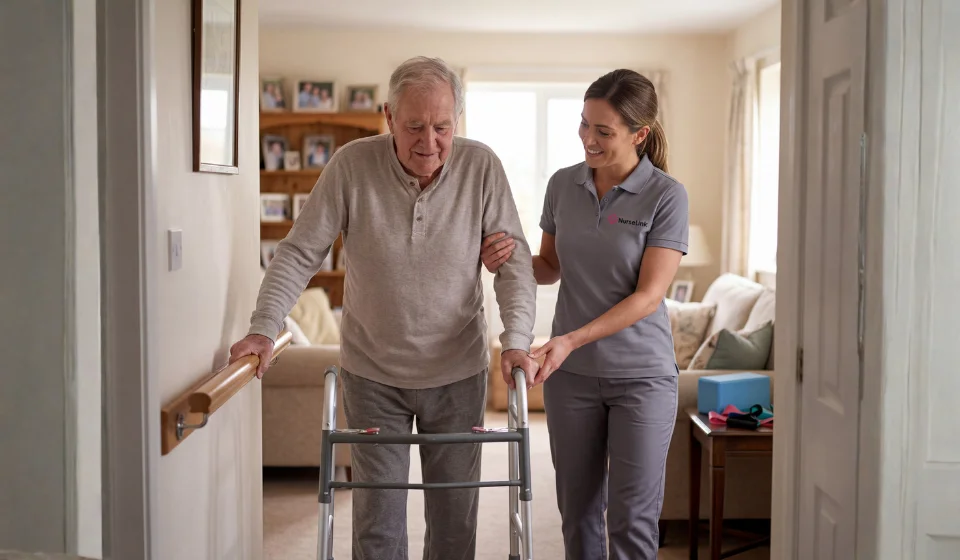
By the third month of care, he was walking independently within the house with a walking aid. By the fourth month, he was spending time in the garden again. Slowly, carefully, and with someone nearby – but in his garden, in his home, on his own terms.
Keeping The Family Connected & Informed
His daughter had returned to work, as she had needed to. His other children were managing the distance between their lives and their father’s recovery with the particular kind of guilt and helplessness that families in this situation know well. NurseLink Healthcare’s care coordinator maintained regular communication with the family, providing honest updates about his progress, flagging anything that warranted their attention and giving them the genuine picture they needed rather than a managed version of it.
That transparency mattered. It allowed the family to show up as his children rather than as anxious monitors – to sit with him, watch the cricket, eat the meals his wife still somehow found the energy to cook, and simply be present in the way that family is meant to be.
Outcomes & Impact
He Came Home, And He Stayed Home
The most fundamental outcome of this engagement was the one the whole family had hoped for and feared might not be possible. He was discharged from hospital to his own home, and he remained there throughout his recovery. The residential facility conversation that had loomed at the point of discharge never had to be had again. NurseLink Healthcare’s structured homecare support made the clinical case for home possible, and the human quality of the care made it liveable.
His Recovery Progressed Beyond Initial Expectations
His treating physiotherapist noted at the five-month mark that his functional progress had exceeded the trajectory they had anticipated at discharge. Consistent daily support at home, the maintenance of rehabilitation exercises between outpatient appointments and the overall stability of his routine had contributed to a recovery arc that was genuinely encouraging. He was not the man he had been before the stroke, and that grief was real. But he was more than anyone had dared to predict in those first frightening weeks.
His Wife Could Be His Wife Again
The client’s wife, speaking with the NurseLink Healthcare care coordinator toward the end of the formal engagement period, said something that has stayed with the team:
“I spent the first weeks after he came home feeling like I was failing him every hour of the day, because I couldn’t do everything he needed and I was so frightened of getting it wrong. When NurseLink came in, I stopped being frightened. I could sit next to him on the couch and just be glad he was there. That is everything.”
The Family Found Its Footing
The broader family, who had moved through the initial post-stroke period in a state of sustained anxiety, gradually found that the presence of a reliable, skilled and genuinely caring team around their father allowed them to settle. Visits became something to look forward to rather than something to brace for. The grandchildren started coming around again. The noise and the life that had always filled that house began, slowly, to return.
Key Takeaways From This Case Study
Home is a clinical option, not just a personal preference. The desire to recover at home is not a sentimental wish that has to be weighed against clinical reality. With the right homecare support in place, home is frequently the safest, most effective and most recovery-positive environment available. NurseLink Healthcare’s role is to make that option viable.
Stroke recovery requires consistency, not just competence. A different support worker at every visit cannot build the relationship or the contextual knowledge that effective stroke homecare depends upon. Consistency of placement is not a luxury. It is a clinical requirement.
The family is part of the care equation. A homecare plan that does not address the needs of the family around the client has addressed only part of what recovery requires. The relief of burden, the restoration of family roles and the peace of mind that comes from genuine clinical oversight are outcomes that matter as much as the client’s own progress.
Clinical monitoring at home saves lives. Secondary strokes are a genuine and serious risk in the months following an initial event. Structured clinical observation, medication management and clear escalation pathways at home are not supplementary. They are essential.
Conclusion
A stroke changes a life in an instant. What happens in the months that follow – where recovery takes place, what support is available, whether the people who love the survivor are held as well as the survivor themselves — shapes the outcome in ways that reach far beyond the clinical.
At NurseLink Healthcare, we understand that homecare after a stroke is among the most complex and consequential forms of support we provide. We hold that responsibility with the full weight it deserves – clinically, practically and humanly – because every person who comes to us after a stroke has already been through enough. What they need now is care that is genuinely worthy of the trust they are placing in us.
If someone you love is facing stroke recovery and you are trying to understand whether home is a realistic option, we encourage you to reach out to the NurseLink Healthcare team today. We would be honoured to help you find the path forward.
Latest Post
Still Going Home
Caring For Dad From Across The Country
Raising Three Kids While Living with Parkinson’s
A Family In Crisis. A Care Team Ready.
Homecare Cleaning Support
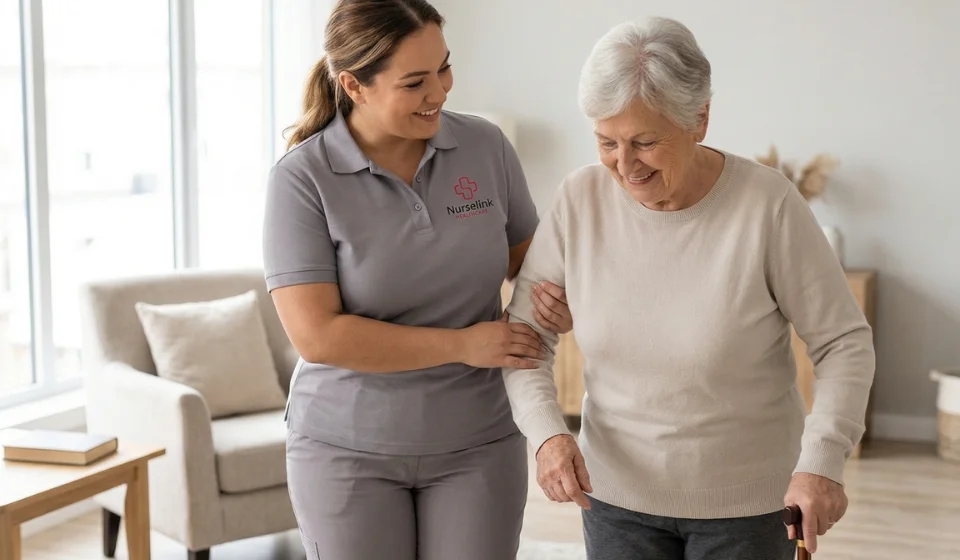
A Journey Of Comfort & Independence Through Homecare Support
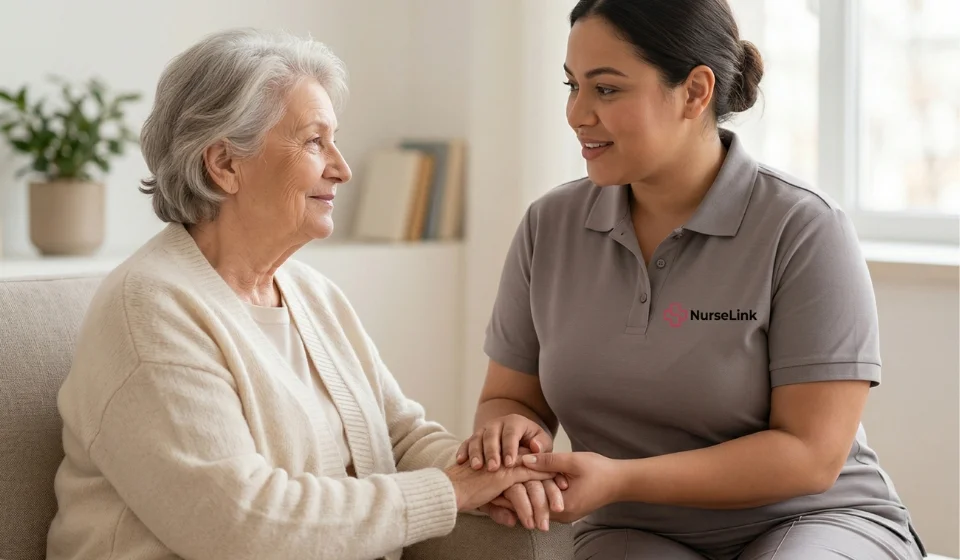
Margaret’s Journey