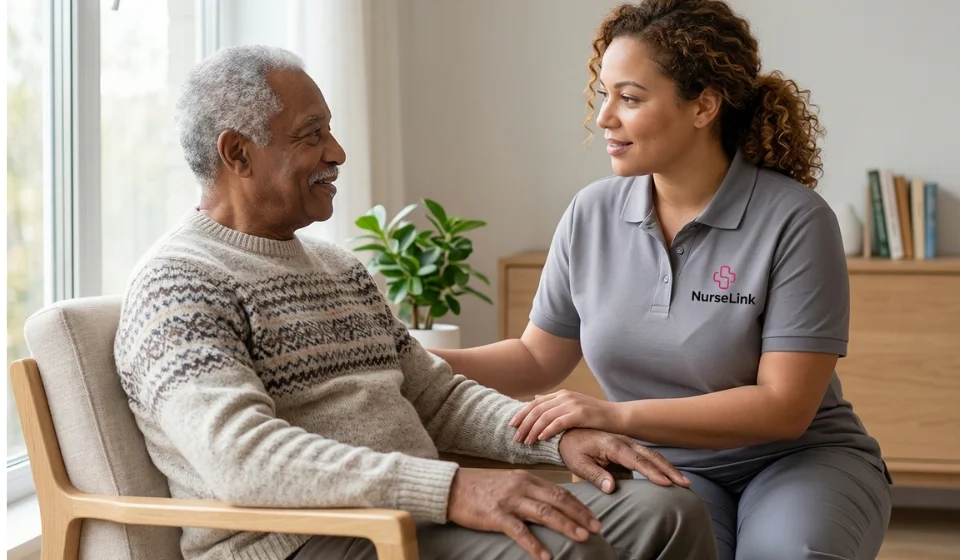
Caring For Dad From Across The Country
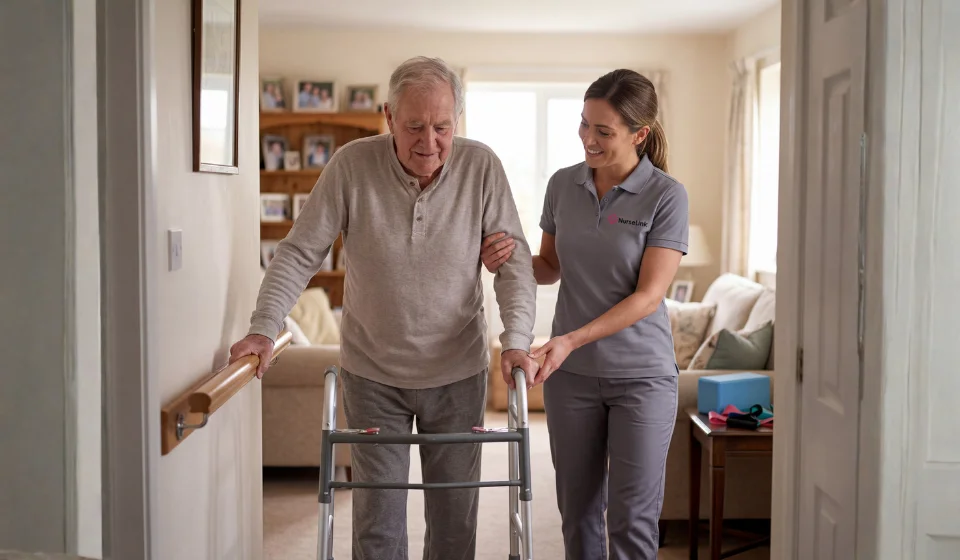
Caring For Dad From Across The Country
How NurseLink Healthcare Delivered Personalised Stroke Recovery Homecare In NSW
Introduction
Stroke is one of the leading causes of disability in Australia. For the person who experiences it, the physical and cognitive aftermath can be immediate and confronting – a sudden, dramatic narrowing of what the body and mind are able to do. For the family around them, it arrives as a crisis that forces decisions that none of them were prepared for, often from a distance and under considerable time pressure.
The period following a stroke is one of the most medically and emotionally complex that a person and their family will navigate. Rehabilitation is demanding and uneven. Progress is real but rarely linear. The risk of a second stroke or a fall during the recovery period is genuine. And the question of how a person returns home – whether they can return home, and under what conditions — is one that carries enormous weight for everyone involved.
For adult children who live in a different state from their elderly parent, the situation carries an additional layer of difficulty. They cannot simply drop in to check. They cannot be there for the morning routine or the evening medication. They are managing fear, guilt and practical responsibility from hundreds of kilometres away, often while holding down jobs and families of their own.
Homecare in this context is not simply about the clinical needs of the person who has had the stroke. It is about giving an entire family the confidence to breathe again. Getting it right requires a provider who understands both dimensions and builds their service around the whole picture.
At NurseLink Healthcare, our homecare services are designed around the whole person and the whole life they are living. This case study documents how our team supported an elderly man in regional New South Wales following a significant stroke, enabling him to return home safely and recover with dignity, while giving his adult children interstate the reassurance they needed to function in their own lives.
To protect the privacy of the client and his family, his name and all identifying details have been kept confidential throughout this case study.
The Client's Background & His Challenges
The client is a man in his early seventies living alone in a regional New South Wales town. He had retired several years earlier after a long career in local government and had settled comfortably into a quiet, self-sufficient life. He owned his home, maintained it well, drove himself to appointments, cooked his own meals and was by all accounts managing independently with no formal support in place.
His two adult children, a son and a daughter, both lived interstate — one in Queensland, one in South Australia. The family was close and in regular contact, but the physical distance meant that day-to-day awareness of how their father was managing relied entirely on phone calls and his own reporting, which, in the way of many independent elderly men, tended toward reassurance rather than full transparency.
The stroke occurred without warning on a weekday morning. A neighbour found him after he failed to appear for their regular morning walk and called an ambulance. He was hospitalised for three weeks, during which time both his children travelled to be with him. The medical team confirmed that the stroke had left him with right-sided weakness affecting his arm and leg, some difficulty with word retrieval, and fatigue that was significantly more pronounced than anything he had experienced before.
The discharge conversation was the moment at which the family understood the scale of what lay ahead. Their father was determined to go home. He had been explicit and, on this point, entirely clear despite his word-finding difficulties: he was not going into a facility. He was going home. The medical team supported this goal but was equally clear that he could not go home without a structured support arrangement in place.
His children were faced with the practical reality of organising that support from interstate, in a regional area they did not know well, for a father who was simultaneously vulnerable and resistant to being treated as such. They were referred to a care coordinator who, following an assessment of the client’s needs and situation, identified NurseLink Healthcare as the most appropriate provider.
The challenges were layered and specific. The physical effects of the stroke meant that personal care tasks — showering, dressing, managing the stairs in his home — had become genuinely risky without support. His fatigue was unpredictable, and the rehabilitation exercises prescribed by the hospital physiotherapist required both supervision and encouragement to be done consistently. His medication regime had become more complex post-stroke, with several new prescriptions added to those he had been managing before. Meal preparation, which he had previously done without thought, now required more time and effort than his energy and right-sided weakness readily allowed.
Beyond the physical dimension, his emotional state required careful attention. He was a proud man who had been entirely self-sufficient for years. The stroke had shaken his confidence profoundly, and beneath the determination to go home was a layer of fear and vulnerability that he was not inclined to name directly. His children, speaking with his care coordinator, were clear that the wrong approach to his care would trigger a withdrawal and resistance that would make everything harder.
Understanding What The Client & His Family Actually Needed
NurseLink Healthcare’s initial engagement with the client and his family involved a thorough assessment that deliberately began with the person rather than the medical event. What had his life looked like before the stroke? What had he valued most about his independence? What were his routines, his habits, his preferences? What did recovery mean to him, and what was he most afraid of losing?
For his children, equally important questions were asked. What did they most need from the support arrangement in order to feel confident that their father was safe? What would make the difference between a constant low-level anxiety and a genuine ability to trust that things were being managed well? How did they want to be communicated with, and how often?
The assessment of the client’s physical needs was thorough and covered all of the areas identified during his hospital discharge planning: personal care and mobility support, rehabilitation exercise supervision, medication management, meal preparation, home safety and falls risk, and transport to the appointments that formed a dense schedule in the weeks following his return home.
The assessment also identified something less clinically straightforward but equally important: that the client needed to feel that his home was still his home. He needed support workers who would work with him, not around him. He needed his space respected and his preferences honoured. He needed to feel that the support he was receiving was helping him get back to himself, not managing a permanent diminishment.
The resulting care plan was built to address the full picture — clinical, practical and personal — with the explicit goal of enabling both a safe recovery and a dignified one.
The NurseLink Healthcare Solution Delivered
Support Scheduled Around Recovery & Rehabilitation
The care schedule was structured around the twin demands of the client’s recovery: the clinical support he needed and the rehabilitation effort that would determine the extent of his long-term recovery. Morning visits covered personal care, medication management and breakfast, the period of day when his physical support needs were highest and when establishing a positive, consistent start to the day had a measurable effect on his engagement with the rest of it. Afternoon visits provided support with rehabilitation exercises, the evening meal and any tasks that had accumulated through the day. Transport to his physiotherapy, occupational therapy and GP appointments was coordinated and provided by NurseLink Healthcare, eliminating one of the most practically complex elements of his early recovery.
Carefully Matched Support Workers
The client’s family had been transparent during the assessment about their father’s personality and what kind of support worker would and would not work for him. He was not a man who wanted to be fussed over. He did not want someone who would talk to him as though he were fragile. He wanted someone competent, calm and capable of engaging with him as an equal.
NurseLink Healthcare selected workers whose clinical experience with post-stroke recovery was strong and whose personal manner matched the brief the family had given. Before the client was discharged from hospital, his primary support worker visited him there – a deliberate step that meant the first face he saw when he arrived home was already a familiar one. The difference this made to the emotional tone of his first days back was, in his daughter’s words, impossible to overstate.
Rehabilitation Exercise Supervision & Encouragement
One of the most consistent findings in post-stroke rehabilitation is that the exercises prescribed during the acute recovery period are done more reliably, more correctly and with better outcomes when there is a consistent, trained presence to support and encourage them. The client’s prescribed programme was incorporated as a structured element of each relevant visit, with his support worker providing both the practical supervision and the steady encouragement that made the difference on days when fatigue made the effort feel pointless.
His physiotherapist, reviewing his progress at the six-week mark, noted that his adherence to the programme had been among the strongest she had observed in a community setting. She attributed this directly to the consistency of the support he had received at home.
Medication Management & Clinical Monitoring
The complexity of the client’s post-stroke medication regime made reliable management a genuine clinical priority. NurseLink Healthcare introduced a structured approach to medication prompting and documentation, with each visit incorporating a clear medication check and a record that formed part of the broader care notes reviewed by his GP. Any changes in presentation, any signs of concerning symptoms, and any falls or near-miss incidents were documented and escalated through the appropriate clinical channels without delay.
This clinical oversight function was something his children had identified as one of their primary concerns, and the knowledge that it was being handled consistently and professionally by people who understood its significance gave them a level of reassurance that phone calls with their father alone could not have provided.
Practical Daily Support That Preserved His Sense Of Capability
The approach to practical daily support was shaped throughout by the principle that the goal was recovery, not dependency. Wherever the client was able to contribute to a task, he was encouraged to do so. The support worker’s role on any given day was calibrated to what he could manage that day — more hands-on when his fatigue was pronounced, more facilitative when he was having a stronger day. The aim was always for him to feel capable rather than cared for, and the distinction mattered enormously to him.
Meal preparation became a particular area where this principle played out meaningfully. His food preferences were documented in detail, he was involved in decisions about what was being prepared, and on days when his energy allowed, he participated in the cooking process rather than simply receiving the outcome.
Communication With His Children Interstate
With both of his children living interstate and unable to visit more than occasionally, the communication structure NurseLink Healthcare put in place was not a supplementary feature of the service. It was a core component of the care arrangement. Following each visit, a brief summary note was made available to both children, covering how their father had presented, what had been covered during the visit, anything of note and any concerns requiring attention.
A direct line of communication was maintained with his care coordinator and GP to ensure that the homecare picture remained connected to his broader clinical management. When a concern arose — as it did on one occasion when his blood pressure readings were presenting outside of expected parameters — the escalation happened promptly and the children were informed the same day. The incident resolved without complication, but the handling of it confirmed to the family that the system around their father was working as it should.
Outcomes & Impact
He Returned Home & Stayed Home
The fundamental goal of the engagement – enabling the client to return safely to his own home following his stroke – was achieved and sustained. In the months following his discharge from hospital, he remained at home without any incident requiring readmission or emergency intervention. His clinical team, reviewing his progress at the three-month mark, described his recovery trajectory as positive and his home environment as safe and well-supported.
His Physical Recovery Progressed Well
The consistency of his rehabilitation exercise programme, supported by NurseLink Healthcare’s involvement, produced a recovery arc that exceeded the initial projections. His right-sided weakness improved meaningfully over the first three months, his mobility became more confident, and the assistive equipment that had been necessary in the early weeks of his recovery was progressively reduced as his capability returned.
His Confidence Came Back
The most personally significant outcome for the client himself was the gradual return of his confidence. In the early weeks following the stroke, he had been shaken in a way that those around him found difficult to see. As the support arrangement settled, as his physical capability improved and as the routines of his old life began to reassemble themselves, the man his children knew started to come back. He began driving again at the three-month mark following clearance from his doctor. He returned to his morning walks. He started talking about the future.
His Children Could Live Their Own Lives Again
Both of the client’s adult children described the period between his stroke and the establishment of the NurseLink Healthcare arrangement as one of the most stressful of their lives. The combination of distance, uncertainty and the practical impossibility of being there had created a state of chronic anxiety that affected their work, their families and their own wellbeing.
With a reliable, professional support arrangement in place, a clear communication structure and a clinical team they trusted, that anxiety reduced to a level they could manage. They were still present in their father’s recovery, but they were present as his children rather than as overwhelmed long-distance crisis managers.
His Independence Was Rebuilt, Not Replaced
Perhaps the outcome the client himself cared most about was that the support he received had been a bridge back to independence rather than a replacement for it. By the six-month mark, his formal support needs had reduced significantly, and the care plan had been progressively scaled back in line with his improving capability. He was managing more of his daily life under his own steam, with the support remaining in place for the tasks that still genuinely required it.
Client Reflection
The client’s daughter shared her family’s experience several months into the NurseLink Healthcare engagement:
“When Dad had his stroke, we were terrified. We live so far away and we just couldn’t be there every day the way we wanted to be. The NurseLink team understood from the very beginning what our family actually needed – not just what Dad needed medically, but what we needed to feel like he was genuinely safe and cared for. They found someone who got Dad – someone who didn’t treat him like a patient but like a person. He’s driving again now. He’s doing his walks. He’s himself again. We couldn’t have got here without them.”
ConclusionKey Takeaways From This Case Study
Post-stroke homecare must be designed around recovery, not just safety. A care plan that manages the risks of the post-stroke period without actively supporting rehabilitation will produce a slower and less complete recovery. Embedding rehabilitation support as a structured element of the care plan, not as an afterthought, produces measurably better outcomes.
Interstate families have care needs of their own. When an elderly person lives alone and their family is geographically distant, the homecare provider sits in a position of particular importance in the family system. Clear, reliable, timely communication with family members is not a courtesy. It is part of the service.
The introduction of the support worker matters as much as the selection of them. Matching a client with the right support worker is essential, but the way that relationship is introduced shapes whether the match translates into a working arrangement. Taking the time to build familiarity before formal visits begin is an investment that makes every subsequent visit more effective.
Independence must be the goal, not the casualty, of homecare. For a client recovering from a stroke, the risk of homecare is not only physical. It is the risk of a dependency that replaces capability rather than rebuilding it. Support that is deliberately calibrated to expand the client’s independence over time produces better clinical and personal outcomes than support that simply manages present limitations.
Regional clients require providers with genuine regional capability. Organising care for a client in a regional area without family nearby requires a provider who can reliably staff, coordinate and communicate across that geography. The distance and isolation that make these clients most vulnerable are the same factors that make consistent, dependable care most difficult to deliver. Providers must be genuinely equipped for the reality of the setting.
Conclusion
Stroke does not ask for a convenient moment. It arrives without warning and changes everything, immediately and permanently, for the person it happens to and for everyone around them. The support required to enable a good recovery – and a return to a life that still feels like one’s own – must be built around that reality in all of its complexity.
At NurseLink Healthcare, we understand that post-stroke homecare for an elderly person living alone is not the same as managing a stable, ongoing care need. The stakes are higher, the timeline is more demanding and the outcome – both the clinical outcome and the human one — depends entirely on the quality and consistency of the support provided in those critical early months.
This case study is an example of homecare at its most purposeful. A man who wanted to go home, recover and get back to his life. A family separated by distance who needed to know he was safe and in good hands. NurseLink Healthcare provided the support that made both possible.
If you or someone you care about is navigating a similar situation and needs a homecare provider who will take the whole picture seriously, reach out to the NurseLink Healthcare team today. We would welcome the opportunity to help.
Latest Post
Caring For Dad From Across The Country
Raising Three Kids While Living with Parkinson’s
A Family In Crisis. A Care Team Ready.
Homecare Cleaning Support
A Journey Of Comfort & Independence Through Homecare Support
Margaret’s Journey