His Land, His Terms
Helping An Elderly Farmer Remain At Home Through Advanced Heart Failure
A Case Study In Remote Homecare Built Around A Man Who Knew Exactly Where He Wanted To Be
Introduction
There is a particular kind of person who has spent a lifetime on the land and for whom the suggestion of leaving it is not simply a practical inconvenience but something closer to an existential loss. The property is not where they live. It is who they are. The paddocks, the sheds, the particular quality of light in the late afternoon and the sounds of a place known so deeply that silence itself is familiar, these are not things that can be relocated to a room in an aged care facility or a daughter’s spare bedroom. They exist only there, on that land, and the person who has built their life around them knows it.
When serious illness arrives for a person like this, the clinical conversation about what is needed and the human conversation about where it can happen are often in tension. The medical team sees risk and complexity. The patient sees home, and cannot imagine anything else.
Homecare in remote and rural Australia, when it is designed with genuine flexibility and genuine respect for the person it is built around, can be the thing that resolves that tension. Not by pretending the clinical complexity does not exist, but by bringing the clinical response to where the person is, rather than requiring the person to go somewhere else to receive it.
At NurseLink Healthcare, we believe that where a person receives care matters as much as the care itself. This case study documents how our team supported an elderly farmer on a remote property outside Broken Hill, New South Wales, through an advanced stage of heart failure, after his family had been told that remaining on his land was no longer safe and after he had made clear, without any ambiguity, that he was not going anywhere.
To protect the privacy of the client and his family, all names and identifying details have been kept confidential throughout this case study.
The Client & His Situation
The client is a man in his mid-eighties who has lived and worked on the same property outside Broken Hill for more than sixty years. He had taken it over from his own father as a young man, had raised three children on it with his late wife, and had continued working it, progressively and with diminishing physical capacity but with undiminished commitment, well into his eighties. His wife had passed away several years earlier, and since then he had lived alone on the property, managing the reduced operation of the farm with the help of a neighbouring family who checked in on him regularly and assisted with the heavier work.
His children, two daughters and a son, were all living in larger regional centres or capital cities, and while they visited as often as their own lives allowed, the practical reality was that their father was largely self-sufficient on a property a considerable distance from the nearest town. He had been self-sufficient for so long that the erosion of that self-sufficiency, which had been happening gradually over several years, had been easy for everyone, including him, to minimise.
The diagnosis of advanced heart failure came after a hospitalisation following a significant episode of breathlessness and fluid retention that had frightened his neighbouring family enough to call an ambulance. He spent two weeks in Broken Hill Base Hospital, where the cardiology team assessed his condition and were honest with his children about what they were seeing. His heart failure was at a stage where exertion carried genuine risk. Daily tasks that most people perform without thought, walking to the shed, carrying anything of weight, managing the physical demands of a rural property, had become genuinely dangerous for a man in his condition. The medical recommendation was clear. He needed a higher level of daily support than his current situation provided, and the remote property, with its distances and its isolation, was not the right environment for managing his condition safely.
He listened to this assessment with the particular patience of a man who has spent a lifetime making decisions about difficult situations and who had already made this one. He was going home. That was not a question. The question was what support could be organised to make it possible.
What The Family Was Facing
His children had arrived at the hospital for a family meeting that included the cardiology team and a social worker, and the conversation had been one of the harder ones any of them had sat through. They understood the clinical picture. They were frightened by it. And they were also, all three of them, the children of the man in the bed, which meant they understood, without needing it explained, that the conversation about moving him into care was not one that was going to go anywhere.
Their challenge was practical and genuine. They could not provide the daily clinical support his condition required. None of them lived close enough to manage it consistently. The neighbouring family who had been his informal support network were willing and caring but had their own property and their own lives, and the level of clinical oversight that advanced heart failure required was beyond what any of them could be expected to provide.
The social worker at the hospital had made contact with several homecare providers in the region, most of whom had been candid about the limitations of their capacity to provide consistent support to a remote property at the distance his was from Broken Hill. The combination of the travel involved, the clinical complexity of his condition and the level of service required had made several providers decline the referral before NurseLink Healthcare was contacted.
His eldest daughter made the call to NurseLink Healthcare on the day before his planned discharge. She was, by her own description, not entirely optimistic that a solution existed. She had been told no enough times in the preceding days to have lowered her expectations considerably.
Understanding What He & His Family Actually Needed
The assessment conversation NurseLink Healthcare had with the client took place at the hospital, the day before his discharge, and it was conducted primarily with him rather than about him, a distinction that mattered to him in a way that was immediately apparent.
He was not a man of many words, and the ones he used were chosen with the economy of someone who had spent a lifetime in landscapes where silence was the default. He said that he needed someone who would come out to the property, help him manage the things he could no longer safely manage alone and leave him to manage the things he still could. He did not want to be watched over. He did not want someone reorganising his kitchen or suggesting he might be more comfortable somewhere else. He wanted support that understood the difference between what he needed help with and what was still his own business.
He also said something that his eldest daughter later described as the most direct thing she had heard him say about his own situation in years. He said that he intended to die on that property, and that the only question was whether he died there well or died there badly, and that he would appreciate help with the former.
His children needed the clinical assurance that his heart failure was being properly monitored, that his medications were being managed correctly and that someone with clinical training was seeing him regularly enough to identify any deterioration before it became a crisis. They needed after-hours contact availability, because the geography of his situation meant that the distance between him and the nearest emergency service was significant and the margin for delay in a cardiac event was narrow. And they needed honesty, the same honesty he had asked for, about how he was doing and how things were changing.
NurseLink Healthcare built the care plan around all of this.
The NurseLink Healthcare Solution
A Support Worker Who Could Meet Him Where He Was
Finding the right support worker for this engagement required more than matching clinical credentials to care needs. The person going out to that property needed to be someone who could exist comfortably in a remote rural environment, who understood the particular culture of a man of his generation and background and who would not, through manner or approach, make him feel that his way of living was something to be managed or modernised.
NurseLink Healthcare identified a support worker with a rural background of her own, experience in remote area care and the kind of practical, unsentimental warmth that a man like this would accept more readily than any amount of professionally delivered empathy. Before her first visit, she was briefed thoroughly on his condition, his preferences, his property and the specific clinical requirements of managing advanced heart failure in a remote setting. She was also briefed, in terms that left no ambiguity, on the importance of following his lead about what help was welcome and what was not.
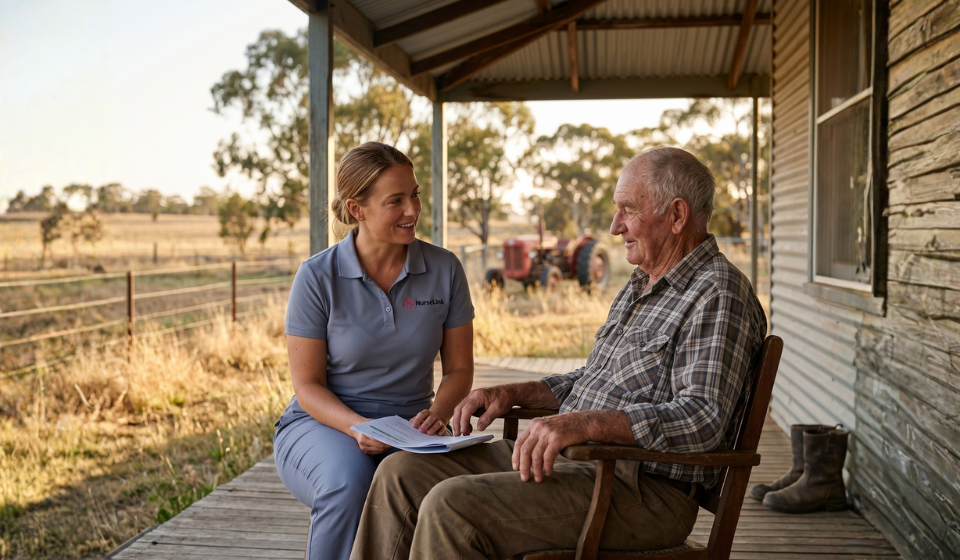
Her first visit to the property was not a clinical assessment. It was an introduction. She drove out, met him on the veranda where he was sitting in the late afternoon light, and they talked for a while about the property and the season and the particular challenges of running cattle in that country. The clinical relationship that followed was made possible by that conversation, because he had decided, by the end of it, that she was someone he could tolerate having around.
Clinical Monitoring Brought To His Door
NurseLink Healthcare’s care plan incorporated structured cardiac monitoring at every visit, including daily weight checks to identify fluid retention, blood pressure and heart rate monitoring, respiratory assessment and a systematic review of his symptom profile against the specific indicators that would signal a deterioration in his heart failure status. His cardiologist in Broken Hill had provided a clear clinical framework for what to watch for and what required escalation, and every visit incorporated that framework without making it feel like a clinical inspection.
His medication regime, which included several cardiac medications that required consistent timing and careful management, was overseen through a structured prompting and documentation process that gave his treating team in Broken Hill a reliable clinical picture of his adherence and any concerns. His GP, who visited the property periodically as part of a broader rural outreach arrangement, maintained regular communication with NurseLink Healthcare’s care coordinator to ensure the clinical picture was being assembled consistently from all inputs.
Practical Support That Respected His Independence
The support provided at each visit was calibrated carefully to what he actually needed help with, rather than what a clinical framework might suggest he should need help with. He was assisted with personal care on the days when his fatigue and breathlessness made it genuinely difficult. He was helped with meal preparation in a way that incorporated the dietary requirements of his cardiac condition without requiring him to stop eating the food he had eaten his whole life, adjusted rather than replaced. Household tasks that carried exertion risk were managed without fuss and without commentary.
What was not touched was everything else. The sheds, the equipment, the daily ritual of walking to the fence line to check the cattle, which he continued to do at his own pace and which his support worker accompanied him on as a presence rather than a supervisor. The rhythm of his days, the particular way he organised his time on a property he had known for sixty years, was treated as something to be supported and protected, not assessed and adjusted.
After-Hours Availability & Emergency Preparedness
The geographic reality of his situation required that the after-hours arrangement be built with specific attention to the response time implications of his location. NurseLink Healthcare’s after-hours contact line was available to him and to his children at all times, and the escalation pathway for a cardiac event had been established, rehearsed and communicated to the neighbouring family who remained his closest physical neighbours.
His eldest daughter, who had taken on the role of primary family contact, had direct access to the NurseLink Healthcare care coordinator and received regular updates about her father’s condition that were honest, specific and delivered with the clinical detail she needed to understand what was actually happening, not a softened summary designed to manage her anxiety.
Outcomes & Impact
He Remained On His Property
The outcome that had seemed uncertain, and that several other providers had suggested was not achievable safely, was achieved. He returned to his property on the day of his hospital discharge and remained there throughout the period of NurseLink Healthcare’s involvement. He woke up each morning in his own house, looked out at his own land and went to sleep each night in the place where he had lived for sixty years. That continuity, which is easy to describe and difficult to fully value without understanding what it meant to him, was the foundation on which everything else rested.
His Heart Failure Was Managed More Consistently Than Before
The structured clinical monitoring that NurseLink Healthcare’s visits provided gave his treating team in Broken Hill a level of visibility into his condition that they had not had before. Early identification of a fluid retention episode in the second month of the engagement, picked up through the daily weight monitoring protocol, allowed his medications to be adjusted by his cardiologist before the episode became a hospitalisation. His treating GP noted, at a review several months into the engagement, that his heart failure management had been more consistent and better monitored since NurseLink Healthcare’s involvement than at any point in the preceding year.
His Children Found A Way To Be His Children
His three children, who had spent the weeks around his hospitalisation in a state of sustained fear about what his situation meant and what they were going to do about it, found that the presence of a reliable, clinically competent and genuinely trustworthy care arrangement around their father gave them something they had not had for some time. They could visit him on the property, sit on the veranda with him in the late afternoon and be his children, rather than people trying to solve a problem that felt unsolvable.
His eldest daughter, who had made the initial call to NurseLink Healthcare in a state of considerable desperation, described the change in her relationship with her father’s situation in terms that were simple and entirely sufficient. She had stopped being frightened every time her phone rang.
He Passed Away On His Property
He passed away on his property, in his own home, several months after NurseLink Healthcare’s involvement began. His death was not unexpected, and it was not the result of a clinical failure or a gap in his care. It was the natural progression of a condition that his medical team had been honest about from the beginning. He was comfortable. His support worker was present, and his eldest daughter, who had driven up the day before when his condition had indicated the time was close, was with him.
It was the death he had said he wanted, in the place he had said he wanted it, and NurseLink Healthcare’s role had been to make that possible.
A Reflection From His Eldest Daughter
In a conversation with the NurseLink Healthcare care coordinator in the weeks following her father’s passing, his eldest daughter shared the following:
“Dad knew he was dying. He had known for a while, and he had made his peace with it in the way that people who have lived close to the land tend to do. What he could not make his peace with was the idea of dying somewhere else. NurseLink made it possible for him to stay. Not just physically possible, but genuinely possible, in a way that respected who he was and how he had always lived. He died in his house, looking out at his land. That is everything he asked for. I will never stop being grateful.”
Key Takeaways From This Case Study
Where a person receives care is part of the care itself. For some people, the environment of care is inseparable from the quality of that care. A person who is profoundly connected to a place, who has lived their identity through that connection for decades, does not receive the same quality of care in a facility that they receive on their own land. Homecare that can reach people where they are is not simply a logistical convenience. It is a clinical and human necessity.
Remote homecare requires flexibility that standard metropolitan models cannot always provide. The travel distances, the geographic isolation and the practical realities of supporting a person on a remote rural property require a provider with the capacity and the willingness to operate outside the standard service radius. NurseLink Healthcare’s response to this engagement was built around what the client needed, not around what was convenient to provide.
Respecting autonomy is not the same as ignoring risk. A care plan built around a patient’s clearly expressed wishes, including the wish to remain in a place that carries clinical risk, is not a plan that ignores that risk. It is a plan that manages it as well as possible within the reality the patient has defined. NurseLink Healthcare’s approach to this engagement held both the clinical requirements and the client’s autonomy simultaneously, without sacrificing one for the other.
The right support worker is the entire foundation of remote sole-client care. In a remote homecare setting where a single support worker is the primary human presence in a client’s daily life, the fit between that person and the client matters more than in almost any other care context. NurseLink Healthcare’s investment in finding the right person for this particular engagement, rather than the nearest available person, was what made everything else possible.
Conclusion
Some people know where they belong with a certainty that no clinical argument can displace. For the man at the centre of this case study, that certainty had been built over eighty years and sixty of them on the same piece of land. It was not stubbornness. It was identity, and it deserved to be honoured.
NurseLink Healthcare provided the homecare that made it possible for him to live his final months on his own terms, in his own place, with the clinical support his heart failure required and the respect his life had earned. He stayed on his land. He died there. And the family he left behind knows that the people who cared for him in those final months understood what that meant.
If someone you love is facing a serious health decline and is determined to remain at home, however complex or remote that home may be, we encourage you to reach out to the NurseLink Healthcare team. We will do everything in our power to make that possible.
Latest Post
His Land, His Terms
Coming Home Differently
The Caregiver’s Pause
Still Going Home
Caring For Dad From Across The Country
Raising Three Kids While Living with Parkinson’s
A Family In Crisis. A Care Team Ready.
Homecare Cleaning Support
A Journey Of Comfort & Independence Through Homecare Support
Margaret’s Journey