
Managing Diabetes Without Sight
How NurseLink Supported A Blind Elderly Woman In Sydney To Manage Diabetes At Home A Case Study In Homecare Built Around A Woman Who Had Always Done Things Herself & Was Not About To Stop Introduction Independence, for a person who has built their life around it, is not simply a preference. It is an identity. It is the accumulation of decades of managing, adapting and solving the problems that life presents without waiting for someone else to solve them first. When a new diagnosis arrives in a life like this, the clinical challenge is real, but the deeper challenge is the one the clinical team does not always see. The challenge of a person who has always been capable confronting a condition that requires a kind of help she has never needed and is not sure she knows how to accept. For a woman who has been blind for most of her adult life, the adaptations that sighted people take for granted have been made and remade across decades, until the workarounds are so deeply embedded in her daily life that they no longer feel like workarounds. They are simply how she does things. The kitchen she navigates by memory and touch. The routines she has built around the particular intelligence of a person who has learned to inhabit her world fully without sight. The independence that is, to the people who know her, one of the most defining things about her. A diabetes diagnosis does not care about any of this. It arrives with its own requirements, its own monitoring protocols, its own medication regime and the particular clinical complexity of managing blood glucose in a person who cannot read a standard glucometer, whose dietary management requires specific knowledge and whose falls risk is elevated by the combination of age, neuropathy and the absence of the visual cues that most people use to navigate space. Homecare in this situation is not the imposition of support on a person who does not want it. It is the careful, respectful construction of a support arrangement that a fiercely independent person can accept because it is built around what she needs rather than around assumptions about what a blind elderly woman with diabetes requires. Getting that right takes listening. It takes patience. And it takes the particular kind of professional respect that one capable person extends to another. At NurseLink Healthcare, we understand that the person receiving care is always the expert on her own life. This case study documents how our team supported a blind elderly woman in Sydney, New South Wales, through the management of a new diabetes diagnosis at home, alone and on her own terms. To protect the privacy of the client, all names and identifying details have been kept confidential throughout this case study. The Client & His Family’s Situation The client is a woman in her early eighties who has lived alone in a Sydney apartment for over fifteen years, since the death of her husband, and who has been managing blindness since her late forties, when a progressive retinal condition had taken her sight over the course of several years. She had not, by any account of the people who knew her or her own account of herself, allowed the loss of her sight to substantially alter the shape of the life she intended to live. She had worked as a school administrator until her retirement, navigating the workplace with the combination of assistive technology, personal organisation and sheer professional competence that had made her blindness largely invisible to the colleagues and parents and students she worked with. She had travelled. She had maintained a wide social circle. She had lived, in the apartment she had chosen specifically for its layout and its proximity to the amenities she used regularly, with a level of independent daily functioning that was the product of decades of practical intelligence applied to the particular problems of navigating the world without sight. She had no children. Her husband had been her closest companion and the years since his death had been, by her own description, a process of adaptation to a different kind of life that she had undertaken with the same practical determination she brought to everything else. She had friends, a small number and carefully maintained. She had a GP who had known her for years and who had a clear and respectful understanding of the kind of person she was. And she had, when the diabetes diagnosis arrived, a strong and clearly expressed view about what it was going to mean for how she lived. The diagnosis had been made during a routine blood test that her GP had ordered as part of a health review. The results had indicated type 2 diabetes that had likely been developing for some time and that required active management. Her GP had explained the implications clearly and had anticipated, correctly, that the conversation about what management would look like was going to require some specific thought about her particular circumstances. The standard management approach for a new diabetes diagnosis involves blood glucose monitoring, dietary modification, medication management and regular clinical review. For a patient who cannot read a standard glucometer display, whose dietary management requires specific adaptation for a person who cooks independently without sight and whose medication regime requires a level of organisation that blindness complicates, the standard approach required rethinking. Her GP referred her to NurseLink Healthcare with a specific and thoughtful account of what she needed and who she was. Understanding What She Actually Needed The initial assessment NurseLink Healthcare conducted was one that the care coordinator had prepared for carefully, because the referral from her GP had made clear that the assessment was going to be as much about getting the approach right as it was about gathering clinical information. She was direct from the outset, which the care coordinator had been prepared for and which she found, in practice, entirely refreshing. She said
The Recovery Nobody Predicted
How NurseLink Supported A Perth Stroke Survivor Beyond His Clinical Prognosis A Homecare Case Study In Ambition, Clinical Safety And A Family That Believed Him Introduction A stroke prognosis is not a prediction. It is an estimate, made by clinicians who have seen many stroke recoveries and who understand, from that experience, what the likely trajectory looks like for a person with a particular pattern of damage in a particular area of the brain. The estimate is usually honest and usually well-intentioned and sometimes, for the person it is delivered to, entirely wrong. Not because the clinicians were mistaken about the clinical picture. But because the clinical picture does not fully account for the person inside it. The determination that refuses to treat a ceiling as a ceiling. The particular stubbornness of a man who has always done things his own way and who sees no reason why a stroke should change that. The family that decides, against the weight of medical caution, to believe in the version of recovery that the statistics do not support but that the person they love is insisting is possible. Homecare in this context is not simply the clinical management of a post-stroke patient in a home setting. It is the infrastructure that makes an ambitious recovery possible. The structured support that allows a man who is pushing hard against his own limitations to do so safely. The clinical oversight that catches the signs of overexertion before they become setbacks. The practical assistance that removes the daily friction that would otherwise consume the energy he needs for the recovery work itself. And the human presence that holds the family steady while they navigate the particular experience of watching someone they love fight for something they are not sure he can reach. At NurseLink Healthcare, we believe that recovery belongs to the person doing it, and that our role is to support it as far as it will go. This case study documents how our team supported a man in his fifties in Perth, Western Australia, through a stroke recovery that exceeded every clinical projection, and the family that learned, alongside him, to redefine what recovery looked like. To protect the privacy of the client and his family, all names and identifying details have been kept confidential throughout this case study. The Client & His Family’s Situation The client is a man in his mid-fifties who lives in Perth with his wife and their two teenage children. He had spent most of his working life in a senior project management role in the resources sector, a career that suited a person who was decisive, energetic and not particularly accustomed to being told what he could or could not do. He was, by his wife’s account and his own history, a man who operated at a pace that the people around him often found difficult to keep up with, who had strong views about most things and who had never, in the course of their marriage, accepted a limitation he did not believe was necessary. The stroke occurred at work, in the middle of an ordinary morning, and was severe enough that his colleagues had called the ambulance before he had fully understood what was happening. He was admitted to a major Perth hospital, where the acute management of his stroke was handled with the speed and the clinical thoroughness that the severity of his presentation required. He spent two weeks in the acute setting followed by three weeks in inpatient rehabilitation. The stroke had affected the left side of his brain, producing right-sided weakness that was significant but not complete, speech difficulties that had improved considerably during his inpatient rehabilitation but that still required ongoing speech therapy, and cognitive changes including fatigue and processing speed reductions that his rehabilitation team had assessed as likely to persist and to place meaningful limits on his return to his previous level of work and activity. His rehabilitation team had been honest with him and with his family at discharge. The recovery to date had been good. The prognosis for further improvement was cautiously optimistic in some areas and more guarded in others. He would likely continue to make gains over the following months. The ceiling they described was not a ceiling they said with certainty, but it was the ceiling that their clinical experience suggested was realistic, and they were clear that his previous pace of work and life was probably not what recovery was going to return him to. He had listened to this with the particular patience of a man who was waiting for the clinicians to finish so he could tell them what he had decided. He had decided he was going to get back. What The Family Was Navigating His wife had been present for every clinical conversation since the stroke, and she had absorbed what the rehabilitation team had said with the combination of hope and realism that she had brought to most of the significant challenges of their marriage. She understood what the clinical team was telling them. She also understood her husband, and she knew that the version of recovery he had decided on was not the one the clinical team was describing. She was not sure who was right. She hoped it was him, because she always hoped it was him, and because the alternative was something she was not ready to fully face. But she was also frightened in the way that the spouse of a man who is pushing hard against his own limitations is frightened, not of the pushing itself but of what would happen if the pushing produced a setback that the recovery could not absorb. Their teenage children had managed the stroke and its aftermath in the ways that teenagers manage serious family events, which is to say with a mixture of visible resilience and invisible processing that their parents could see the edges of but not the full extent of. Their son, who
Finding Their Footing Again
How NurseLink Healthcare Helped A Mother Living With Severe Osteoporosis A Case Study In Homecare That Held A Whole Family Together While One Of Them Was Breaking Apart Introduction Osteoporosis is one of those conditions that most people have heard of and very few people fully understand until it arrives in their family. It is not dramatic in the way that a heart attack is dramatic or visible in the way that a stroke is visible. It is quiet and progressive and its consequences arrive without warning, a fracture from a movement that would not have registered as anything the year before, a vertebra that compresses under the ordinary weight of an ordinary morning, pain that does not resolve in the way that pain is supposed to resolve and that begins, over time, to shape every decision about how to move through a day. For the person living with severe osteoporosis, the condition takes more than bone density. It takes confidence. The confidence of a person who once moved through the world without calculating every step is replaced by a vigilance that is exhausting and by a fear that is entirely rational, because the consequences of a fall are not a bruise and a fright but a fracture and a hospitalisation and a recovery that may not return everything it borrows. For the family around that person, the condition takes something too. It takes the version of their mother or grandmother or wife that existed before the fear arrived and the pain became constant and the world outside the house began to feel less like a place she belonged to and more like a place that was waiting to hurt her again. Homecare that understands all of this, that addresses the clinical management of a complex condition while also attending to the isolation and the fear and the family that is reorganising itself around a new reality, can be the thing that helps a family find the shape of a life that still works. At NurseLink Healthcare, we build our care around exactly this understanding. This case study documents how our team supported an elderly woman in Canberra, Australian Capital Territory, living with severe osteoporosis and multiple fractures, and the family that was trying, alongside her, to find a new normal. To protect the privacy of the client and her family, all names and identifying details have been kept confidential throughout this case study. The Client & Her Situation The client is a woman in her late seventies who had lived in the same Canberra suburb for over forty years, in a house she and her late husband had moved into when their children were small and that she had remained in through widowhood and retirement and the gradual quieting of a life that had once been full of noise and people and the particular busyness of a woman who had always found it easier to be useful than to be still. She had three adult children. A son who lived in Canberra, a daughter who lived in Sydney and a younger daughter who lived in Queensland. All three were closely involved in their mother’s life, visiting regularly and staying in frequent contact, and all three had been watching the progression of her osteoporosis with the particular anxiety of adult children who love their parent and cannot fix what is happening to her. The osteoporosis had been diagnosed several years earlier and managed initially with medication and lifestyle modifications that had slowed but not stopped its progression. Over the preceding eighteen months, she had sustained three fractures, two vertebral compression fractures that had produced significant and persistent back pain, and a wrist fracture from a fall in the kitchen that had shaken her confidence in a way that the physical recovery had not fully restored. She moved carefully, which was necessary and which had the secondary effect of moving less, which was not good for her bones or her mood or her connection to the life she had always lived. She had not left the house independently for several months. She had stopped hosting the monthly lunches she had been holding for a group of friends for years, because the preparation involved was too physically demanding and the fear of a fall with guests present was too present to manage alongside the hosting. She had, in the quiet way of a person who does not want to make a fuss, become smaller. Her son, who visited most frequently by virtue of living in the same city, had noticed the change with the particular sharpness of someone who had known her all his life. The woman who had run a household and worked part time and driven her grandchildren to after-school activities was spending most of her days in her chair, in pain, managing the hours until her children called. He had raised the question of additional support with his sisters, and the three of them had together reached out to NurseLink Healthcare. What The Family Was Navigating The conversation the three siblings had with each other before they contacted NurseLink Healthcare was one that many families in this situation will recognise. The guilt of the two who lived interstate, who visited when they could and called often and knew that this was not the same as being there. The weight on the one who was there, who was doing more than the other two and felt the inadequacy of what more looked like against what was actually needed. The shared grief of children watching a parent become a smaller version of herself and not knowing how to help. Their mother, for her part, was managing something that she did not fully name to any of them. She was frightened. Not dramatically, not in a way she would have described as fear, but in the persistent, low-level way of a person who has fallen and knows what falling costs and cannot stop thinking about it. Every movement contained a calculation.
On His Own Terms
How NurseLink Helped A Family Stay Together With Multiple Sclerosis A Case Study In Compassionate Homecare Built Around A Man Who Knew Exactly How He Wanted To Spend The Time He Had Left Introduction Motor neurone disease takes things in a particular order. Not the same order for everyone, because MND is inconsiderate in that way, varying its progression across the people it touches with a randomness that can feel almost deliberate. But it takes things. Speech, often, before the end. The use of hands. The ability to swallow without assistance. The breath that comes and goes without thought until the day it does not come as easily as it did. And alongside all of this, in the background of every conversation and every medical appointment and every morning that begins a little harder than the one before, the knowledge of what is coming and the decision about how to face it. For the man at the centre of this case study, that decision had been made early and without ambiguity. He wanted to be at home. He wanted to spend whatever time he had in the place he had built his life, surrounded by the people and the things that made that life his own. He did not want his final chapter to be written in a facility, however good the care might be, because the facility was not his story and home was. Homecare for a person with motor neurone disease is among the most complex and most clinically demanding forms of in-home support that exists. The progression of the disease requires care that evolves continuously, adapting to losses as they arrive and maintaining the quality of daily life that the person has asked for in the face of a condition that is systematically reducing what is possible. It requires clinical skill, genuine compassion and the particular kind of presence that does not flinch. At NurseLink Healthcare, we hold this responsibility with the full weight it deserves. This case study documents how our team supported a middle-aged man in Brisbane, Queensland, through the progressive stages of motor neurone disease at home, and how the adult child watching from a distance found, through NurseLink Healthcare’s involvement, a way to carry the helplessness of being far away without being consumed by it. To protect the privacy of the client and his family, all names and identifying details have been kept confidential throughout this case study. The Client & His Situation The client is a man in his early fifties living in Brisbane’s northern suburbs. He had spent most of his working life in project management, a career that had suited a person who was organised, direct and comfortable making decisions under pressure. He had been divorced for several years and lived alone in a house he had renovated largely himself over the decade since the divorce, a practical, comfortable space that reflected his preference for things that worked well and were kept in good order. He had two adult children. His son lived in Brisbane and visited regularly. His daughter had moved to London several years earlier for work, had built a life there and had, until her father’s diagnosis, been managing the ordinary guilt of an adult child living far from ageing parents with the ordinary reassurances that distance and regular phone calls provide. The MND diagnosis had arrived eighteen months before his engagement with NurseLink Healthcare, following a period of unexplained weakness in his right hand that had progressed to his arm and then, over the following months, had made itself known in other ways. The neurologist who delivered the diagnosis had been honest and careful, and he had received the information in the way that people who are accustomed to managing difficult situations tend to receive it, with a focus on what came next rather than what had been lost. What came next, he had decided, was home. His neurologist, his GP and the palliative care team who became involved in his management had all discussed the option of residential care with him, and he had listened to each conversation with the same polite attention and the same conclusion. He was going home, and he was staying there, and he needed to know what support could be organised to make that possible for as long as possible. The Distance His Daughter Was Managing When her father called her in London to tell her about the diagnosis, his daughter had sat with the phone in her hand for a long time after the call ended. She had looked up MND that evening, which was both the inevitable thing to do and, she later said, the thing she wished she had not done quite so thoroughly quite so soon. The progression. The timeline. The specific things it would take and when it would take them. She had booked a flight to Brisbane within the week and had spent two weeks with her father, during which they had talked about the diagnosis with a directness that had surprised and moved her, made decisions together about what his care was going to look like and established the arrangement with NurseLink Healthcare that would be the clinical infrastructure of his homecare from that point forward. And then she had flown back to London, because her life was there and because he had told her, clearly and without any room for negotiation, that he did not want her to upend her life on his account. He wanted her to visit. He wanted to talk to her every day. He did not want her sitting in Brisbane watching him decline when she had a life she had built and people she loved on the other side of the world. She had agreed, because he was her father and she understood him, and because disagreeing would not have changed his mind. And she had spent the months that followed managing the particular texture of helplessness that belongs to a person who loves someone deeply
When MS Moves In, The Whole Family Feels It
How NurseLink Helped A Family Stay Together With Multiple Sclerosis A Case Study In Homecare Built Around A Young Mother, A Devoted Husband And Two Children Introduction Multiple sclerosis does not only happen to the person who is diagnosed. It happens to everyone who loves them. It happens to the husband who lies awake at night listening for sounds from the bedroom, running through the list of things he managed today and the longer list of things he did not, wondering how long he can keep holding this together before something gives. It happens to the children who are too young to fully understand what is wrong with their mother but old enough to feel that something has changed in the house, that the mum who used to run with them in the park now watches from the window, that some mornings she cannot get up, and nobody quite explains why. And it happens to the woman at the centre of it. Not just in the physical reality of a disease that takes things from her progressively and without apology, but in the particular grief of a mother who wanted to be present for her children’s childhood in a way that her condition is making increasingly difficult. Who measures her losses not just in clinical terms but in the school drop-offs she has missed and the birthday cakes she could not help decorate and the bedtime routines that her husband now manages alone because she does not have enough left at the end of the day. Multiple sclerosis in a young mother is not a condition to be managed in isolation. It is a family experience, and the care built around it needs to understand and honour that truth. At NurseLink Healthcare, we know that homecare for a young parent with a progressive neurological condition is not simply about the clinical tasks a visit covers. It is about what those tasks make possible for the person receiving the care and for the family living alongside her. This case study documents how our team supported a woman in her early forties in Sydney, New South Wales, living with progressive multiple sclerosis, and the husband who had been carrying more than any one person should carry alone, through a period in which the right homecare made the difference between a family that was drowning and one that could breathe. To protect the privacy of the client and her family, all names and identifying details have been kept confidential throughout this case study. The Client & Her Family’s Situation The client is a woman in her early forties living in Sydney’s inner west with her husband and their two children, a daughter aged eight and a son aged six. She had been a secondary school art teacher before her diagnosis, a career she had loved and that had suited a person who was naturally creative, energetic and deeply invested in other people. She had been diagnosed with relapsing-remitting multiple sclerosis in her mid-thirties, and for the first several years the condition had been manageable alongside work, alongside parenting, alongside the full and busy life she and her husband had built together. The transition to secondary progressive MS had changed the picture significantly. The relapses that had once resolved, leaving her largely functional between episodes, had given way to a steadier and less forgiving form of progression. Her mobility had declined. Fatigue, the kind that is not solved by rest and that does not respond to willpower, had become the defining feature of most of her days. She had stopped teaching the previous year, a loss she had not fully processed and did not often speak about. She used a walking frame at home and a wheelchair for anything beyond short distances. Her hands, which had once held a paintbrush with the ease of someone who had been doing it since childhood, were less reliable than before, and the tremor that came and went without warning had taken from her things she mourned quietly and privately. Her husband had absorbed all of this alongside his own full-time work and the primary parenting of two children who were at an age where they needed a great deal and understood only some of what was happening in their family. He was, by any measure, an exceptional person. He was also, by the time NurseLink Healthcare first spoke with him, running on the last of what he had and had not told anyone how close to the edge he actually was. He had not sought home care support because he had not allowed himself to believe that he could not manage. He was her husband. These were his children. The idea of needing someone to come in and help with the things he felt he should be able to handle had felt, for a long time, like a form of failure. It had taken his wife, who understood what she was carrying and who loved him too much to keep watching it, to be the one who insisted they look for help. What The Family Was Actually Living With The mornings in their house had become the hardest part of the day. Getting two primary school-aged children fed, dressed and ready for school while also managing the complex morning care routine that his wife’s condition required had become a daily exercise in triage. Something always did not get done. The children sometimes went to school with their hair unbrushed. He sometimes forgot his own breakfast entirely. She sometimes could not complete her morning routine before he had to leave, and the guilt of that, for both of them, sat in the house long after the front door had closed. The children had adapted in the way that children do, which is to say they had absorbed the tension of the household into themselves without having anywhere to put it. Their daughter had become quietly anxious in a way that her teacher had raised gently with her
The Nurse Who Became The Patient
How NurseLink Supported A Retired Nurse With Parkinson’s Disease A Case Study In Sensitive, Dignity-Led Homecare For A Woman Who Spent Her Life On The Other Side Of It Introduction There is a particular kind of difficulty that comes with needing care when you have spent your life giving it. A nurse who has managed wards, administered medications, assessed patients and advocated for the dignity of others in their most vulnerable moments does not become a different person when illness arrives at her own door. She is still the professional who knows what good care looks like. She is still the person who understands exactly what is happening to her body and what the progression of her condition is likely to mean. And she is still, beneath all of that clinical knowledge, a person who has always been the one doing the caring, not the one receiving it. Parkinson’s disease does not care about any of this. It arrives with its own timeline and its own demands, progressive, unpredictable and deeply personal in how it affects the daily reality of the person living with it. For a woman who has built her identity around independence, clinical competence and the capacity to manage whatever comes her way, the incremental losses that Parkinson’s imposes can feel like an assault not just on her body but on who she understands herself to be. Homecare for a person like this requires something beyond clinical skill, though clinical skill is essential. It requires the particular kind of professional respect that one clinician extends to another, the willingness to follow the lead of a person who knows more about healthcare than most of the people who will ever come through her door, and the patience to earn trust from someone who knows exactly what corners can be cut and will not accept it if they are. At NurseLink Healthcare, we understand that the person receiving care is always the expert on their own life, and when that person is also an expert on care itself, that understanding has to be applied with particular care and particular humility. This case study documents how our team supported a retired nurse in her seventies in Hobart, Tasmania, living with Parkinson’s disease, through the process of accepting and then genuinely valuing homecare support, after months of managing alone in ways that her condition no longer safely permitted. To protect the privacy of the client and her family, all names and identifying details have been kept confidential throughout this case study. The Client & His Situation The client is a woman in her mid-seventies who spent over four decades working as a registered nurse in Hobart, including many years in acute medical and surgical wards and a final decade in clinical education, training the next generation of nurses at a Tasmanian hospital she had been part of for most of her career. She had retired several years before the events of this case study, reluctantly and on her own terms, and had filled her retirement with the same purposeful energy that had characterised her working life. A large garden, a wide circle of friends, an ongoing involvement with a local community health advisory group and the particular satisfaction of a person who has always known how to be useful. Her Parkinson’s diagnosis had come three years before she was referred to NurseLink Healthcare, and the progression of her symptoms over that period had been gradual but steady. Tremor in her dominant hand had been the first sign, followed by changes in her gait and balance that she had initially managed with the practical resourcefulness of someone who knows how to adapt. Medication had helped, and continued to help, but the nature of Parkinson’s is that adaptation is a process without an end point, and the adjustments required had grown in number and in significance as the months had passed. By the time her GP raised the question of homecare support, she was managing falls risk that her own clinical judgment told her was real but that she had not been willing to formally acknowledge. She had stopped telling her daughter, who lived in mainland Australia and visited when she could, the full picture of how her days were going. She had modified her garden to reduce the tasks she could no longer manage safely, without telling anyone she had done so. And she had begun, on some days, to spend more time in her chair than was good for her, not from choice but from the particular fatigue that Parkinson’s imposes and that she was managing alone. Her GP had known her for years and had learned how to have direct conversations with her. The homecare conversation had not been easy, but it had been honest, and she had not dismissed it. She had said she would think about it, which her GP knew, from experience, was as close to yes as she was likely to get on the first attempt. The Referral & What It Revealed The referral to NurseLink Healthcare came through her GP, accompanied by a clinical summary and a personal note that the care coordinator found both helpful and illuminating. The note described a patient with significant clinical knowledge, strong views about the standard of care she would and would not accept, a tendency to assess the competence of anyone who came through her door within approximately the first three minutes of meeting them and a deep, if currently suppressed, understanding that she needed more support than she was allowing herself to receive. The care coordinator who took the referral understood immediately that the initial assessment conversation was going to be unlike most. She was not going to be meeting a patient who needed to be educated about her condition or guided toward an understanding of what care might look like. She was going to be meeting a clinician, retired in name but not in professional identity, who would be evaluating NurseLink Healthcare as much as
His Land, His Terms
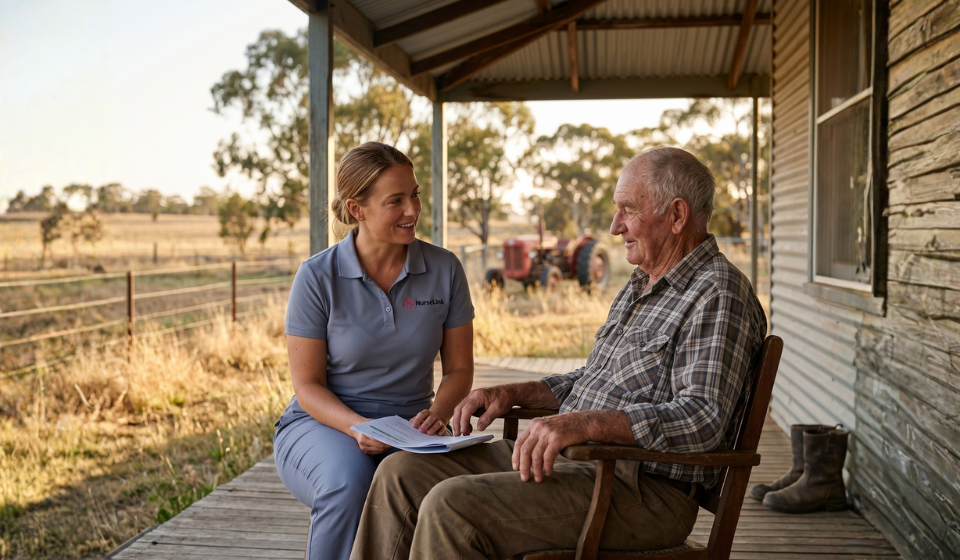
Helping An Elderly Farmer Remain At Home Through Advanced Heart Failure A Case Study In Remote Homecare Built Around A Man Who Knew Exactly Where He Wanted To Be Introduction There is a particular kind of person who has spent a lifetime on the land and for whom the suggestion of leaving it is not simply a practical inconvenience but something closer to an existential loss. The property is not where they live. It is who they are. The paddocks, the sheds, the particular quality of light in the late afternoon and the sounds of a place known so deeply that silence itself is familiar, these are not things that can be relocated to a room in an aged care facility or a daughter’s spare bedroom. They exist only there, on that land, and the person who has built their life around them knows it. When serious illness arrives for a person like this, the clinical conversation about what is needed and the human conversation about where it can happen are often in tension. The medical team sees risk and complexity. The patient sees home, and cannot imagine anything else. Homecare in remote and rural Australia, when it is designed with genuine flexibility and genuine respect for the person it is built around, can be the thing that resolves that tension. Not by pretending the clinical complexity does not exist, but by bringing the clinical response to where the person is, rather than requiring the person to go somewhere else to receive it. At NurseLink Healthcare, we believe that where a person receives care matters as much as the care itself. This case study documents how our team supported an elderly farmer on a remote property outside Broken Hill, New South Wales, through an advanced stage of heart failure, after his family had been told that remaining on his land was no longer safe and after he had made clear, without any ambiguity, that he was not going anywhere. To protect the privacy of the client and his family, all names and identifying details have been kept confidential throughout this case study. The Client & His Situation The client is a man in his mid-eighties who has lived and worked on the same property outside Broken Hill for more than sixty years. He had taken it over from his own father as a young man, had raised three children on it with his late wife, and had continued working it, progressively and with diminishing physical capacity but with undiminished commitment, well into his eighties. His wife had passed away several years earlier, and since then he had lived alone on the property, managing the reduced operation of the farm with the help of a neighbouring family who checked in on him regularly and assisted with the heavier work. His children, two daughters and a son, were all living in larger regional centres or capital cities, and while they visited as often as their own lives allowed, the practical reality was that their father was largely self-sufficient on a property a considerable distance from the nearest town. He had been self-sufficient for so long that the erosion of that self-sufficiency, which had been happening gradually over several years, had been easy for everyone, including him, to minimise. The diagnosis of advanced heart failure came after a hospitalisation following a significant episode of breathlessness and fluid retention that had frightened his neighbouring family enough to call an ambulance. He spent two weeks in Broken Hill Base Hospital, where the cardiology team assessed his condition and were honest with his children about what they were seeing. His heart failure was at a stage where exertion carried genuine risk. Daily tasks that most people perform without thought, walking to the shed, carrying anything of weight, managing the physical demands of a rural property, had become genuinely dangerous for a man in his condition. The medical recommendation was clear. He needed a higher level of daily support than his current situation provided, and the remote property, with its distances and its isolation, was not the right environment for managing his condition safely. He listened to this assessment with the particular patience of a man who has spent a lifetime making decisions about difficult situations and who had already made this one. He was going home. That was not a question. The question was what support could be organised to make it possible. What The Family Was Facing His children had arrived at the hospital for a family meeting that included the cardiology team and a social worker, and the conversation had been one of the harder ones any of them had sat through. They understood the clinical picture. They were frightened by it. And they were also, all three of them, the children of the man in the bed, which meant they understood, without needing it explained, that the conversation about moving him into care was not one that was going to go anywhere. Their challenge was practical and genuine. They could not provide the daily clinical support his condition required. None of them lived close enough to manage it consistently. The neighbouring family who had been his informal support network were willing and caring but had their own property and their own lives, and the level of clinical oversight that advanced heart failure required was beyond what any of them could be expected to provide. The social worker at the hospital had made contact with several homecare providers in the region, most of whom had been candid about the limitations of their capacity to provide consistent support to a remote property at the distance his was from Broken Hill. The combination of the travel involved, the clinical complexity of his condition and the level of service required had made several providers decline the referral before NurseLink Healthcare was contacted. His eldest daughter made the call to NurseLink Healthcare on the day before his planned discharge. She was, by her own description, not entirely
Coming Home Differently
How NurseLink Supported A Young Woman With A Spinal Injury A Case Study In Transitional Homecare For A Young Person Rebuilding Life After A Life-Changing Injury Introduction There is a particular kind of courage required to leave a rehabilitation hospital. The ward, for all its clinical sterility, has become familiar. The routines are known. The nurses know your name, your preferences, your rhythms. Help is always close. And then comes the day when the discharge papers are signed, the car is waiting at the entrance, and a person who has spent months learning how to exist in a completely new body is asked to do that in the place they used to call home, which now looks and feels entirely different from the inside. For a young person, the transition from hospital to home following a serious spinal injury carries a weight that is difficult to fully articulate. It is not simply a clinical event. It is the beginning of a new chapter of life that was never planned for, arriving at an age when the plans were supposed to be about something else entirely. The future that existed before the injury must be reimagined. The home that was once effortless must be relearned. And the people who love that person most, parents, siblings, friends, must find a way to be present and supportive without the clinical knowledge to know what helping actually looks like. Homecare following spinal injury, when it is built with genuine understanding of what a young person in this situation actually needs, can be the thing that makes the difference between a transition that is survivable and one that is genuinely good. At NurseLink Healthcare, we understand the complexity and the tenderness of this moment, and we build our support around both. This case study documents how our team supported a woman in her early twenties in Geelong, Victoria, through the first months at home following a spinal injury sustained in a recreational accident, at a point when the gap between what she needed and what her family alone could provide was significant. To protect the privacy of the client and her family, all names and identifying details have been kept confidential throughout this case study. The Client & Her Situation The client is a woman in her early twenties who had been living independently in Geelong, sharing a house with friends and working in the hospitality industry, when a recreational accident during a weekend trip resulted in a spinal injury that changed the course of her life entirely. The injury left her with incomplete paraplegia, meaning she retained some sensation and limited movement in her lower limbs but required a wheelchair for mobility and was dependent on assistance for a significant range of daily tasks she had previously managed without a second thought. She spent several months in a spinal rehabilitation unit following her acute hospital stay, working with physiotherapists, occupational therapists and specialist spinal nurses to understand her injury, develop her functional capacity and prepare for discharge. The rehabilitation team had done excellent work. By the time discharge was being planned, she had made real progress. She was motivated, determined and had a realistic understanding of what her life at home was going to require. What she was returning to, however, was not the independent share house she had left. Her parents, who lived in Geelong and with whom she had maintained a close relationship despite living separately, had prepared their home for her return. Modifications had been made. A hospital grade bed had been organised. The family had done everything they could to be ready. But her parents, both working full time and without any clinical background, were facing the reality of supporting a daughter with complex care needs that neither of them had been trained for. The spinal rehabilitation team, reviewing the discharge plan, identified a significant gap between what the family could realistically provide and what she needed, particularly in the early months when her care requirements were most intensive and the routines of managing her injury at home were still being established. A referral to NurseLink Healthcare followed. Understanding What She Actually Needed The initial assessment NurseLink Healthcare conducted was one that the client herself led with considerable clarity. She was young, she was articulate and she had spent months in rehabilitation thinking carefully about what her life at home needed to look like. She had views, and she expressed them directly. She did not want to feel like a patient in her parents’ home. She had already spent months being a patient. What she wanted was support that helped her be as independent as possible within her current functional capacity, that treated her as an adult making decisions about her own life and that did not hover or infantilise or assume that a spinal injury had also affected her judgment or her personality. She wanted support workers who would take their lead from her, not the other way around. She was specific about the clinical side of care as well. Bowel and bladder management following spinal injury is a significant and complex clinical requirement, and she needed support workers who were trained in this area and could provide that care without making her feel diminished by needing it. Skin integrity monitoring was essential, as pressure injuries represent a serious risk for wheelchair users and early identification of any concern needed to be built into every visit. Her medication regime and the monitoring of her general health in the context of her injury also required clinical attention. Her parents, in their own conversation with the NurseLink Healthcare care coordinator, were honest about what they needed too. They needed to know that the clinical aspects of their daughter’s care were genuinely covered, because the fear of getting something wrong, of missing a sign of a pressure injury developing or mismanaging a clinical situation they did not understand, was sitting heavily on them both. They needed guidance on how to be
The Caregiver’s Pause
How NurseLink Healthcare Gave A Devoted Husband The Respite He Needed A Real World Example of Respite Home Care That Helped A Carer Restore Balance Introduction There is a particular kind of exhaustion that builds in a person who has become a full-time carer for someone they love. It does not arrive all at once. It accumulates in the missed appointments they keep meaning to reschedule, the friends they have not seen in months, the sleep that is never quite enough, and the slow erosion of a life that used to belong to them too. And because the person they are caring for needs them so completely, the carer often does not notice how much of themselves has quietly disappeared until something, or someone, points it out. Family carers across Australia hold an enormous amount of the country’s care responsibility, often without formal training, without adequate breaks and without anyone checking in on how they themselves are doing. The focus, understandably, tends to stay on the person receiving care. But a carer who is running on empty cannot sustain the quality of care their loved one needs, and eventually, something has to give. Respite care exists to interrupt that trajectory before it reaches a breaking point. Done well, it is not simply a service that allows a carer to step away for a few hours. It is a form of genuine relief, built on trust, that gives a person permission to rest without guilt, knowing that the person they love is receiving care that is every bit as attentive as their own. At NurseLink Healthcare, our respite homecare services exist for exactly this reason. This case study documents how our team supported a husband on the Gold Coast, Queensland, who had been caring for his wife full time following a significant decline in her health, after a previous care arrangement had broken down and left him more depleted than he had been willing to admit. To protect the privacy of the client and his wife, all names and identifying details have been kept confidential throughout this case study. The Couple & Their Situation The couple at the centre of this case study had been married for close to forty five years. They had raised two children on the Gold Coast, both of whom had since moved to other states for work, and had spent their retirement years in the same modest home they had lived in for decades, close to the beach they had walked along most mornings for as long as either of them could remember. His wife had always been the more outgoing of the two, the one who remembered birthdays and organised the family gatherings and kept in touch with an enormous circle of friends. He had been content, throughout their marriage, to be the quieter partner, happy to let her run the social side of their life while he tended the garden and did the crossword and loved her in the steady, undemonstrative way that some people simply do. A series of health events over an eighteen month period changed their life considerably. A fall that resulted in a hip fracture, followed by complications during recovery, followed by a diagnosis of early vascular dementia that had likely been present for some time before it became clinically apparent, left his wife with significantly reduced mobility, increased confusion, particularly in the late afternoons and evenings, and a level of dependency for daily tasks that neither of them had anticipated needing to plan for so soon. He had stepped into the role of full time carer without hesitation, because that is who he was and because the alternative, in his mind, was unthinkable. He had not, in the eighteen months since her decline began, taken a single day where he was not the person responsible for her care. What Went Wrong Before NurseLink Healthcare In the months before engaging NurseLink Healthcare, the couple had tried a different home care arrangement, organised through a smaller local provider that a friend had recommended. On paper, the arrangement had seemed reasonable. A support worker was scheduled to come for a few hours twice a week, ostensibly to give him a break and to provide some additional support for his wife. In practice, the arrangement fell apart within a matter of weeks. The support worker assigned changed almost every visit, meaning his wife, whose confusion made unfamiliar faces particularly distressing, was unsettled by each new person arriving at the house. On more than one occasion, the scheduled worker did not arrive at all, with no notice given, leaving him without the break he had been counting on and, more importantly, leaving his wife without the support that had been planned for that day. The final breaking point came when a support worker, new to the household and apparently not properly briefed on his wife’s needs, left her alone in the lounge room for an extended period while attending to another task, during which she had become distressed and attempted to get up unassisted, resulting in a near fall that, had it gone differently, could have caused serious injury. He cancelled the arrangement immediately and did not seek out an alternative for several months. He told the NurseLink Healthcare care coordinator, much later, that he had simply decided it was safer and easier to do everything himself than to risk another experience like that one. What he did not say, at first, was how much that decision had cost him. It was his GP, during a routine appointment for his own health that he had nearly cancelled twice, who noticed how exhausted he looked and asked him directly how he was coping. The conversation that followed was the first time in eighteen months that anyone had asked him that question and waited for a real answer. His GP referred him to NurseLink Healthcare that same week. Understanding What He & His Wife Actually Needed The initial conversation NurseLink Healthcare had with him was,
Still Going Home
A Real-World Story of Homecare After a Life-Changing Stroke How NurseLink Healthcare Supported A Family Through Stroke Recovery At Home Introduction A stroke arrives without warning. One moment, a person is living their ordinary life – getting dressed, making breakfast, talking with someone they love. And then, in the space of minutes, everything changes. Not just for the person it happens to, but for every member of the family gathered around the hospital bed in the days that follow, trying to understand what recovery might look like and whether home is still a realistic destination. For many stroke survivors in Australia, the road between hospital discharge and a return to meaningful daily living is longer, harder and lonelier than anyone anticipates. The medical team does what it can within the limits of an acute care setting. And then the family takes over, often without the clinical knowledge, the physical capacity or the emotional reserves to do so safely or sustainably. Homecare, when it is thoughtfully designed and genuinely delivered, can change that equation entirely. It can be the thing that makes recovery at home not just possible, but purposeful – turning what might otherwise be a frightening and isolating experience into one where progress, however gradual, is genuinely felt. At NurseLink Healthcare, our homecare services are built on the belief that recovery belongs at home whenever it safely can. This case study documents how our team supported a stroke survivor in Brisbane, Queensland, and his family through four to six months of intensive home-based rehabilitation support, at a point when the alternative was a long-term care facility. To protect the privacy of the client and his family, all names and identifying details have been kept confidential throughout this case study. The Client & His Situation The client is a man in his late sixties who had lived an active and largely independent life in Brisbane’s inner south. He had retired from a long career in logistics management several years prior, and retirement had been good to him. He gardened, he cooked, he walked regularly with his wife of more than forty years, and he was a fixture in the lives of his three adult children and five grandchildren, who visited often and loudly. The stroke occurred at home on an ordinary Tuesday morning. His wife found him on the kitchen floor, confused and unable to move his right side. The ambulance arrived quickly, and he was admitted to hospital where he spent the better part of three weeks in acute care and early rehabilitation. The stroke had affected the left side of his brain, producing significant right-sided weakness, difficulty with speech and fatigue that was unlike anything he had experienced before. The rehabilitation team at the hospital was honest with the family about what lay ahead. Recovery from a stroke of this severity was possible, but it would take time, consistent effort and the right level of support. He would need ongoing physiotherapy and occupational therapy input. He would need help with personal care, mobility and medication management. He would need someone who knew what to look for in terms of secondary stroke risk and who could respond appropriately if his condition changed. The question the family was grappling with, when NurseLink Healthcare first spoke with them, was whether all of that could happen at home. His wife, a warm and capable woman who had never once considered anything other than bringing her husband home, was nevertheless honest about her limitations. She was in her mid-sixties herself, managing a mild cardiac condition, and the physical demands of full-time caregiving for a partially immobile man were beyond what she could safely take on alone. Their eldest daughter, who lived closest of the three children, had taken leave from work to help in the immediate period following discharge, but that arrangement could not continue indefinitely. Without structured homecare support in place, the hospital’s discharge planners had flagged that placement in a residential aged care facility or rehabilitation centre would need to be considered. For a man who had told his wife with absolute clarity that he wanted to go home, that was not a conversation anyone in the family wanted to have. Understanding What The Client & His Family Needed The assessment NurseLink Healthcare conducted prior to the care plan being developed was built around listening as much as observing. The client, whose speech had improved meaningfully during his hospital stay but who still found extended conversation tiring, was clear about the things that mattered to him. He wanted to be in his own home. He wanted to sleep in his own bedroom. He wanted to be able to sit in the garden. And he wanted, above everything else, to not feel like an invalid in the life he had built. His wife needed something different but equally important. She needed to know that the clinical side of things was genuinely covered – that someone with the right skills and knowledge was monitoring her husband’s condition, managing his medications and keeping an eye out for the warning signs that she had been given a list of but did not fully understand. She needed to be his wife, not his nurse. Their daughter, who had been holding the family together through the hospital period with enormous grace and growing exhaustion, needed to be able to return to her own life without feeling that she was abandoning her father. And the broader family, the other two adult children, the grandchildren, the sons-in-law and daughters-in-law who all cared deeply and visited as often as they could – needed to feel that the arrangement was safe. That the person they loved was not at risk. That if something changed, someone would know. The care plan NurseLink Healthcare developed addressed all of this directly. The NurseLink Healthcare Solution A Care Team Built For The Complexity Of Stroke Recovery Stroke recovery at home requires a particular combination of clinical knowledge and personal warmth. The support workers and