
When MS Moves In, The Whole Family Feels It
How NurseLink Helped A Family Stay Together With Multiple Sclerosis
A Case Study In Homecare Built Around A Young Mother, A Devoted Husband And Two Children
Introduction
Multiple sclerosis does not only happen to the person who is diagnosed. It happens to everyone who loves them.
It happens to the husband who lies awake at night listening for sounds from the bedroom, running through the list of things he managed today and the longer list of things he did not, wondering how long he can keep holding this together before something gives. It happens to the children who are too young to fully understand what is wrong with their mother but old enough to feel that something has changed in the house, that the mum who used to run with them in the park now watches from the window, that some mornings she cannot get up, and nobody quite explains why.
And it happens to the woman at the centre of it. Not just in the physical reality of a disease that takes things from her progressively and without apology, but in the particular grief of a mother who wanted to be present for her children’s childhood in a way that her condition is making increasingly difficult. Who measures her losses not just in clinical terms but in the school drop-offs she has missed and the birthday cakes she could not help decorate and the bedtime routines that her husband now manages alone because she does not have enough left at the end of the day.
Multiple sclerosis in a young mother is not a condition to be managed in isolation. It is a family experience, and the care built around it needs to understand and honour that truth.
At NurseLink Healthcare, we know that homecare for a young parent with a progressive neurological condition is not simply about the clinical tasks a visit covers. It is about what those tasks make possible for the person receiving the care and for the family living alongside her. This case study documents how our team supported a woman in her early forties in Sydney, New South Wales, living with progressive multiple sclerosis, and the husband who had been carrying more than any one person should carry alone, through a period in which the right homecare made the difference between a family that was drowning and one that could breathe.
To protect the privacy of the client and her family, all names and identifying details have been kept confidential throughout this case study.
The Client & Her Family's Situation
The client is a woman in her early forties living in Sydney’s inner west with her husband and their two children, a daughter aged eight and a son aged six. She had been a secondary school art teacher before her diagnosis, a career she had loved and that had suited a person who was naturally creative, energetic and deeply invested in other people. She had been diagnosed with relapsing-remitting multiple sclerosis in her mid-thirties, and for the first several years the condition had been manageable alongside work, alongside parenting, alongside the full and busy life she and her husband had built together.
The transition to secondary progressive MS had changed the picture significantly. The relapses that had once resolved, leaving her largely functional between episodes, had given way to a steadier and less forgiving form of progression. Her mobility had declined. Fatigue, the kind that is not solved by rest and that does not respond to willpower, had become the defining feature of most of her days. She had stopped teaching the previous year, a loss she had not fully processed and did not often speak about. She used a walking frame at home and a wheelchair for anything beyond short distances. Her hands, which had once held a paintbrush with the ease of someone who had been doing it since childhood, were less reliable than before, and the tremor that came and went without warning had taken from her things she mourned quietly and privately.
Her husband had absorbed all of this alongside his own full-time work and the primary parenting of two children who were at an age where they needed a great deal and understood only some of what was happening in their family. He was, by any measure, an exceptional person. He was also, by the time NurseLink Healthcare first spoke with him, running on the last of what he had and had not told anyone how close to the edge he actually was.
He had not sought home care support because he had not allowed himself to believe that he could not manage. He was her husband. These were his children. The idea of needing someone to come in and help with the things he felt he should be able to handle had felt, for a long time, like a form of failure. It had taken his wife, who understood what she was carrying and who loved him too much to keep watching it, to be the one who insisted they look for help.
What The Family Was Actually Living With
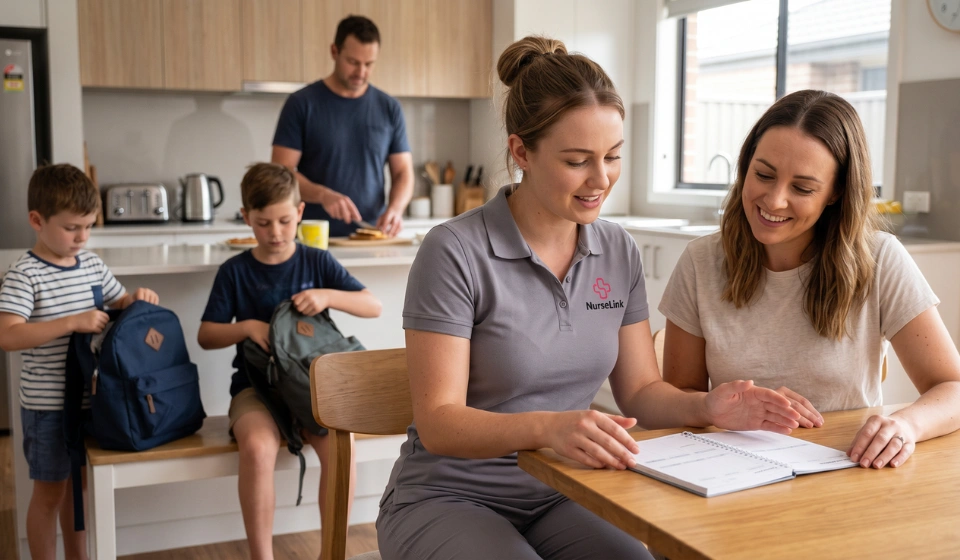
The mornings in their house had become the hardest part of the day. Getting two primary school-aged children fed, dressed and ready for school while also managing the complex morning care routine that his wife’s condition required had become a daily exercise in triage. Something always did not get done. The children sometimes went to school with their hair unbrushed. He sometimes forgot his own breakfast entirely. She sometimes could not complete her morning routine before he had to leave, and the guilt of that, for both of them, sat in the house long after the front door had closed.
The children had adapted in the way that children do, which is to say they had absorbed the tension of the household into themselves without having anywhere to put it. Their daughter had become quietly anxious in a way that her teacher had raised gently with her parents at a school meeting. Their son had started having difficulty sleeping, getting up in the night and appearing at their bedroom door for reasons he could not articulate. Neither child was struggling dramatically. Both children were carrying something that children their age should not have to carry.
She, for her part, was managing a grief that she did not have the energy to fully feel. The loss of her teaching. The loss of the physical ease she had once taken for granted. The particular sorrow of watching her children’s childhood pass through a window, present but not fully participating. And the love she had for her husband, which was enormous and real, alongside the guilt of knowing what her illness was costing him and being unable to do anything about it.
He had cried once, in the car on the way home from her neurology appointment, when she could not see him. He had pulled over for a few minutes and then driven the rest of the way home and made dinner and put the children to bed and sat with her until she fell asleep. That was the version of himself he was performing every day, and it was costing him more than he had left.
Understanding What The Family Actually Needed
The initial conversation NurseLink Healthcare had with the family was notable for how quickly it became honest. He had come to the conversation prepared to be efficient and practical, to describe the clinical requirements of his wife’s condition and the specific tasks that support visits would need to cover. He had lasted about ten minutes before something in the care coordinator’s manner, the simple fact of someone asking him, directly and without agenda, how he was doing, had broken through the efficiency he had been keeping himself behind.
What emerged was not just a list of care tasks. It was a picture of a family that had been managing something enormous without enough help, and the particular toll that had taken on every member of it.
She needed consistent support with her morning routine, the personal care, positioning and mobility assistance that her condition required in the part of the day when her fatigue and stiffness were at their worst. She needed someone who could be present during the periods of peak vulnerability and who could provide the clinical monitoring that her MS management required, including assessment of any new or changing symptoms and coordination with her neurology team.
He needed, although it took longer to say, permission. Permission to not be the only one. Permission to go to work in the morning having completed his share of the morning without having also completed hers. Permission to be her husband in the evenings instead of her carer, to sit with her on the couch and talk about something other than medications and appointments and whether she had managed to drink enough water.
And the children needed something simpler and more fundamental than either of their parents had the capacity to give them at the moment. They needed their mornings to be calmer. They needed their mother to be present with them rather than managing the physical demands of getting through the morning. They needed, in the wordless way of primary school aged children, for the house to feel less frightened.
The NurseLink Healthcare Solution
A Support Worker Who Understood The Whole Family
NurseLink Healthcare’s selection of the right support worker for this engagement was guided by the full picture the initial conversation had revealed, not just the clinical requirements of her MS management but the family context in which that management was happening. She needed a support worker with specific neurological homecare experience and the clinical skills to manage the morning care routine that her condition required. She also needed, as the mother of two young children in a household that had been under strain, someone whose presence in the house in the mornings would make the mornings feel better rather than simply more complicated.
The support worker NurseLink Healthcare assigned had a background in neurological homecare and a natural warmth with families that made her suited to an environment where two children would be getting ready for school at the same time as their mother was receiving care. She was experienced enough to be clinically confident and personable enough to be a genuinely positive presence in a household that needed that as much as it needed the clinical support.
Before her first visit, the care coordinator spoke with both parents together about who was coming and what the first morning would look like. She spoke with the children, briefly and simply, explaining that someone was going to come and help their mum get ready in the mornings so that Dad could help them get ready for school. The eight-year-old had asked if the person was nice. The care coordinator had said yes, she was very nice. The six-year-old had asked if she liked dogs. Their family had a dog. The care coordinator had checked, confirmed that she did and reported back. It was a small thing. It mattered.
Mornings Transformed
The change that NurseLink Healthcare’s morning support visits produced in the daily experience of the family was, by the account of everyone in it, more significant than any of them had fully anticipated.
He could complete the children’s morning routine without simultaneously trying to manage his wife’s. Breakfast happened. Lunchboxes were packed. Hair was brushed. The six-year-old found his left shoe on the first attempt, which was not previously the norm. They left for school drop-off at a time that was not already ten minutes late, and he returned to find his wife’s morning routine being managed competently and calmly by someone who knew what they were doing.
She, for the first time in longer than she could clearly remember, could focus on her own morning without the awareness of everything else that was not being managed because of it. She could be present with her children before they left for school in a way that the previous morning chaos had not allowed. She could say goodbye to them properly, from her chair in the kitchen while they ate their breakfast, and mean it as something other than a rescue from the morning rather than a start to the day.
The children, who had not been told that anything specific had changed other than that someone new was coming to help, responded to the calmer mornings in the way that children respond to calmer mornings. They were easier. They were lighter. Their daughter’s teacher noted, at a follow-up conversation several weeks into the engagement, that she had seemed more settled in class. Their son stopped appearing at the bedroom door at night.
Clinical Management That Kept Her Neurology Team Informed
Every visit incorporated a structured clinical assessment that included monitoring of her neurological symptoms, documentation of any changes in her functional capacity and review of her medication management. NurseLink Healthcare’s care coordinator maintained regular communication with her neurology team, ensuring that the clinical picture being assembled across visits was available to the specialists managing her MS alongside the daily observations of the support worker who was seeing her most consistently.
On one occasion, midway through the engagement, the support worker identified a change in her speech that was subtle enough that she herself had not registered it as significant but that represented, in the clinical assessment of the support worker, a development that warranted prompt neurology review. The referral was made the same day. Her neurologist, reviewing the documentation, agreed that the change was clinically relevant and adjusted her management plan accordingly. It was the kind of early identification that consistent, skilled clinical presence makes possible and that intermittent or less attentive support would have missed.
Making Space For Him To Be Her Husband
The effect on him was the outcome that the care coordinator had most hoped for and had been least certain would come. He was not a person who accepted relief easily. He had been so long in the role of managing everything that stepping back from any part of it required a conscious act of will that he had to repeat each morning.
But the mornings kept being better. He kept leaving for work having done his share of getting the children ready, without having also exhausted himself managing the clinical demands of his wife’s morning routine. He kept coming home in the evenings to a household that had not spent the day in the particular tension of a morning that had gone wrong. And gradually, across the weeks, something began to return to him that he had not noticed leaving.
He started sitting with her in the evenings without immediately falling asleep from exhaustion. He started asking her about the things she had been thinking about during the day, the ideas she had for the art projects she was working on at home, the podcast she had been listening to, and the memory she had been turning over. He started being her husband again, rather than the person who was keeping her alive, which is what marriage is supposed to be and which their marriage had, for a period, stopped being.
She noticed. She had been waiting for it without knowing she was waiting for it, and when it came back, she cried. Not from sadness. From relief. From the feeling of being seen by the person she loved most as more than her illness.
Outcomes & Impact
The Mornings Became Something Different
The transformation of the family’s morning experience was not a small logistical improvement. It was a daily reset that changed the emotional temperature of the household from one of managed crisis to something recognisably like a family morning. The children went to school calmer. He went to work less depleted. She began the day with more in reserve than the morning had consumed, which meant she had more to give to the hours that followed.
Her Clinical Condition Was Better Monitored
The consistent clinical presence of a trained support worker, combined with structured documentation and regular communication with her neurology team, produced a level of clinical oversight of her MS that had not previously been in place. The early identification of the speech change midway through the engagement was the most significant clinical outcome, but the broader improvement in the consistency of her symptom monitoring and medication management represented an ongoing clinical benefit that her neurology team acknowledged explicitly in a review meeting.
He Stopped Running On Empty
The change in him across the months of the engagement was, by his own account and his wife’s, the most unexpected and the most welcome outcome of all. He had not known how much he had been holding until some of it was taken from him in the best possible way. The person who had been keeping everything together by becoming someone who did nothing but hold things together began, gradually and with considerable personal relief, to become someone again rather than just a function.
He told the care coordinator, at a review meeting several months into the engagement, that he had started going for a run in the evenings once a week, something he had not done in years. He said it with a slight embarrassment, as though a run were a frivolous thing to mention in the context of everything they had been discussing. The care coordinator told him it was not frivolous at all. It was exactly the point.
The Children Got Their Mum Back In The Mornings
The detail that she returned to most often when reflecting on what had changed was the mornings with her children. She could sit with them at the kitchen table while they ate their breakfast and actually be with them, not managing her own discomfort or the logistics of a morning that was already behind. She could help their son with the reading he brought home from school. She could listen to her daughter tell her about the friend drama that was apparently very significant and needed full parental attention. She could be their mum in the mornings in a way that her condition, without the right support, had been making impossible.
That was what she had wanted. It was what she had not been able to ask for, until she asked for it in the only way she could, by asking her husband to find some help.
A Reflection From Her Husband
Several months into the engagement, he shared the following with the NurseLink Healthcare care coordinator:
“I kept thinking that needing help meant I wasn’t enough. That I was supposed to be able to do this on my own because I loved her enough. What I’ve learned is that loving someone enough sometimes means admitting what you can’t do alone and finding people you can trust to help you do it. The NurseLink team gave me my wife back in the mornings. They gave my kids their mum back at the breakfast table. And they gave me, for the first time in a very long time, the space to just be her husband. I didn’t know how much I missed that until I had it again.”
Key Takeaways From This Case Study
MS in a young parent is a family condition, not an individual one. The clinical management of a mother’s multiple sclerosis cannot be separated from its impact on her children and her spouse. Homecare that addresses only the clinical needs of the patient while leaving the family to manage everything else has understood only part of what is at stake.
The spouse carrying everything alone is always part of the clinical picture. A primary carer who is running at the edge of their capacity is a risk factor in the care of the person they love. Supporting the carer, practically and with genuine human attention to what they are carrying, is not a secondary consideration. It is part of what good homecare does.
Mornings matter more than they appear to. The quality of a family’s morning shapes the quality of everything that follows it. For a family managing a progressive neurological condition, a morning routine that is consistently well supported can change the emotional reality of the household in ways that reach far beyond the clinical tasks the support visit covers.
Early clinical identification requires consistent, skilled presence. The neurological change that NurseLink Healthcare’s support worker identified mid-engagement would not have been caught by a less experienced or less attentive clinician. Consistent, skilled clinical presence at every visit is what makes early identification possible, and early identification in MS management has direct implications for clinical outcomes.
Conclusion
Multiple sclerosis does not ask permission, and it does not offer apologies. It takes what it takes, on its own timeline, and the people who love the person living with it absorb those losses alongside the person themselves.
For the family at the centre of this case study, those losses had been accumulating for long enough that the household had begun to organise itself entirely around management and survival, with very little room left for the things that make a family what it is.
NurseLink Healthcare provided the support that gave that room back. Not all of it, because MS does not offer that. But enough. Enough for the mornings to be calmer. Enough for him to go for a run on a Tuesday evening. Enough for her to sit at the breakfast table with her children and be their mother, which is what she had always been and what, with the right help around her, she still was.
If your family is living alongside a progressive condition and the weight of it has become more than one person can carry, we encourage you to reach out to the NurseLink Healthcare team. You do not have to do this alone, and you were never meant to.
Latest Post
When MS Moves In, The Whole Family Feels It
The Nurse Who Became The Patient
His Land, His Terms
Coming Home Differently

The Caregiver’s Pause
Still Going Home
Caring For Dad From Across The Country
Raising Three Kids While Living with Parkinson’s
A Family In Crisis. A Care Team Ready.
Homecare Cleaning Support
A Journey Of Comfort & Independence Through Homecare Support

Margaret’s Journey