
The Weight She Was Carrying
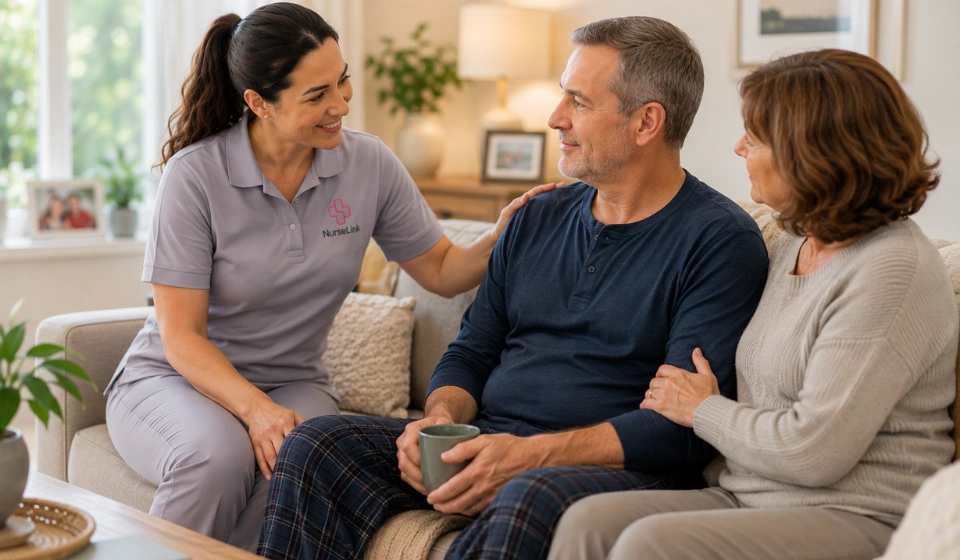
How NurseLink Supported A Woman Through Her Husband's Cardiac Surgery Recovery At Home
A Case Study In Homecare That Looked After Both Of Them
Introduction
Cardiac surgery changes two lives. The person who undergoes it and the person who loves them most. The clinical team focuses, as it should, on the patient. The recovery protocols, the medication regime, the wound care, the activity restrictions, the follow-up appointments, all of it is designed around the person who had the surgery. The person beside them, the one who drove them to the hospital and sat in the waiting room and brought them home and has been managing the practical and clinical demands of recovery ever since, is frequently carrying more than anyone has formally acknowledged.
Post-cardiac surgery recovery at home is not a simple undertaking. The first weeks following a major cardiac procedure require attentiveness and practical support that most households cannot provide adequately without help. Medications must be taken on schedule. Wound care must be managed correctly. Activity restrictions must be maintained in a home environment where a patient who is feeling better than expected does not always see why the restrictions remain necessary. And the person managing all of this is often a spouse without clinical training, working through her own anxiety while simultaneously managing the household, the follow-up appointments and the daily reassurance of the person recovering in the next room.
Homecare that understands this, that addresses not just the clinical needs of the patient but the practical and human needs of the person caring for him, can be the thing that makes a recovery go well rather than the thing that reveals how much one person was being asked to hold alone.
At NurseLink Healthcare, we hold both people in our care. This case study documents how our team supported a man in his sixties in Brisbane, Queensland, through his recovery from major cardiac surgery at home, and the wife who had been managing everything alone for longer than she had been willing to admit.
To protect the privacy of the client and his family, all names and identifying details have been kept confidential throughout this case study.
The Client & His Family's Situation
The client is a man in his mid-sixties who lives with his wife in Brisbane’s southern suburbs. He had worked for most of his adult life in the construction industry before retiring several years earlier, and retirement had suited them both well. They had travelled, spent time with their adult children and grandchildren and settled into the comfortable rhythm of a couple who had been together long enough to know how to make a life together work.
The cardiac event that preceded the surgery had arrived quickly and without significant warning. He was in surgery within days of the diagnostic findings that confirmed what was needed. He came through it well, which his surgical team described with the careful optimism of people who understood that the recovery ahead was going to be significant regardless of how well the procedure itself had gone.
His wife had been present for all of it. The hospital admission, the waiting room during surgery, the recovery ward and the drive home two weeks after the admission, which she had managed with the careful attention of someone who understood that the person in the passenger seat had recently had major surgery and needed to arrive home safely. She was not someone who made a fuss, and she had not made one. She had simply come home with him and started managing what needed managing.
In the weeks that followed, she had been doing the wound dressing checks, managing the medications, enforcing the activity restrictions and keeping track of the follow-up appointment schedule. She had done all of this without complaint and without asking for help, because asking for help was not something she found natural and because she had not fully understood, until she sat in her GP’s office and was asked directly how she was coping, how much of herself she had been spending.
Her GP made the referral to NurseLink Healthcare before the appointment was over.
What She Was Managing
The practical demands of the post-cardiac surgery recovery had been significant from the first day home. The surgical wound required regular assessment and careful dressing. His medications, which included anticoagulants and cardiac medications with specific timing requirements and potential side effects she had been told to watch for, needed to be managed with a precision that she was doing her best to maintain without any clinical background.
The activity restrictions that followed major cardiac surgery are both medically necessary and practically challenging to maintain at home. He was not supposed to lift anything above a certain weight, climb stairs without resting, drive or engage in the ordinary physical activities of a man who had been active and independent for six decades. He was feeling better than he had expected to feel, which was good news clinically and challenging news practically, because the gap between feeling better and being better is one that cardiac patients frequently underestimate and that their spouses are left to navigate.
She had been navigating it. The gentle reminders not to carry that, not to reach for that, to call her before getting up from the chair. She had been doing this alongside everything else, and while none of it was beyond her, all of it together was more than she had been able to fully acknowledge she was managing.
Her children, who lived in other suburbs and visited regularly, had been offering help that she had been declining, partly because she wanted to manage and partly because she did not want them to worry. Her husband, who was genuinely grateful and genuinely trying to do the right thing, was still occasionally doing the wrong thing when her back was turned, not out of stubbornness but out of the particular difficulty of a capable man accepting that he currently needed to be careful.
She was managing. But managing, as her GP had understood when she sat in the consulting room and finally answered the question honestly, had been costing her more than anyone could see.
Understanding What The Family Actually Needed
The initial assessment NurseLink Healthcare conducted was one that her GP had specifically framed as being for both of them, not just for her husband’s clinical recovery, because the GP understood that the household’s ability to sustain the recovery depended as much on her as on him.
She came to the assessment with the particular efficiency of a person who has been managing everything and is accustomed to giving clear accounts of what is happening. She described his current clinical status, his medication regime, the wound care routine and the follow-up schedule with a precision that reflected how thoroughly she had absorbed the discharge information she had been given.
When the care coordinator asked how she herself was finding it, she paused in a way that was slightly longer than a practical question would have required and then said it had been a lot. She did not elaborate immediately. The care coordinator did not push. After a moment she said that she would feel better if someone with clinical knowledge was also keeping an eye on things, because she was not always sure she was catching everything she should be catching and the uncertainty about that was the part she found hardest.
Her husband, who was present for the assessment, listened to this and said something that was brief and that mattered. He said he had not known she felt uncertain about it. He had assumed she was managing because she always managed. She said she was managing but it did not mean she was not finding it hard. It was a short exchange and it was the kind that only happens between two people who have been together long enough to be honest with each other without ceremony.
The care plan NurseLink Healthcare developed was built around what both of them had said.
The NurseLink Healthcare Solution
Clinical Support That Brought Expertise Into The Home
The support workers and registered nurse NurseLink Healthcare assigned to the engagement had specific post-cardiac surgery homecare experience. From the first visit, the clinical management of his recovery had trained eyes on it, assessing the wound, reviewing the medication management, monitoring his vital signs and checking the specific indicators that his discharge paperwork had identified as requiring attention.
His wife received, from the first visit, the clinical confirmation or the clinical correction that she had not known she needed until she had it. When she had been doing something correctly, she was told so, and the telling of it removed the uncertainty that had been a low-level source of anxiety since the discharge. When something needed to be adjusted, the adjustment was made and explained, and the explanation gave her both the correct approach and the understanding of why it was correct, which mattered to her in the way that understanding always matters to a person who is responsible for something she has not been trained for.
The wound care that had been one of her primary areas of concern was taken over as a clinical function, managed correctly and consistently at every visit and documented in a way that gave her husband’s GP and his surgical follow-up team a clear picture of how the wound was progressing. She still had oversight of the process, because it was her husband and she wanted to understand what was happening, but she no longer had to be the person solely responsible for getting it right.
Activity Restriction Management That Did Not Fall To Her Alone
One of the more practically significant contributions NurseLink Healthcare made to the recovery was absorbing a portion of the activity restriction management that had been falling entirely to his wife. The support workers who came each day understood the specific restrictions that his surgery required and managed them with the matter-of-fact authority of clinical professionals, which produced a different response from the patient than the same restrictions delivered by his wife.
This was not because he did not respect her. It was because the dynamic of a long marriage, in which a capable man and a capable woman have managed things their own way for decades, made the clinical authority of an external professional a more neutral and therefore more effective vehicle for the same information. He listened to the support workers in the way that patients listen to clinical staff, which freed his wife from the role of enforcer that she had found both necessary and wearing.
She noticed this within the first week and mentioned it to the care coordinator with the wry acknowledgment of a woman who had understood exactly what had changed and why. She said she did not mind at all.
Wound Care & Medication Oversight
Every visit incorporated a structured clinical assessment that covered his wound status, his vital signs, his medication management and any symptoms that warranted attention. The clinical picture that these visits produced was documented and communicated to his GP and his surgical team, giving both a reliable and current view of his recovery between formal medical appointments.
His medications were reviewed at each visit, with the support worker confirming what had been taken, checking the timing and the dosage against the regime and flagging anything that required the GP’s attention. On one occasion during the engagement, a change in his blood pressure readings prompted a same-day communication to his GP, who adjusted his medication and thanked the NurseLink Healthcare team for the prompt identification. His wife, who had been monitoring his blood pressure herself but had been uncertain about what the readings meant and at what point they required action, found the existence of a clinical escalation pathway that she did not have to manage alone to be one of the most practically significant features of the arrangement.
Giving Her Room To Be His Wife
The dimension of the homecare arrangement that she described as most meaningful, at a review meeting several weeks into the engagement, was not the wound care or the medication management, though she valued both. It was the shift in what her days felt like when the clinical responsibility was shared rather than held by her alone.
She had more capacity than she had had in the weeks before the arrangement began. Not dramatically more, because the situation was still significant and her husband’s recovery was still something she was closely involved in. But enough. Enough to sit with him in the evenings without the clinical checklist running in the background of her attention. Enough to call her daughter and talk about something other than how his recovery was going. Enough to sleep somewhat better than she had been sleeping, because the certainty that a qualified person had assessed him that day and had found things to be on track was a certainty that her own assessment had not been able to provide.
She had not realised, until she had the room, how little room she had had.
Outcomes And Impact
His Recovery Proceeded Well
His cardiac surgery recovery progressed consistently across the engagement period, with his wound healing appropriately, his medications managed correctly and his activity restrictions maintained more successfully than they had been in the period before the homecare arrangement began. His surgical follow-up team, reviewing his progress at his six-week appointment, noted that his recovery was on track and that the quality of his home-based post-operative care had been evident in the clinical picture they were seeing.
His cardiologist, who had been briefed about the homecare arrangement by his GP, noted that the consistent clinical monitoring between formal appointments had given the medical team a more complete picture of his recovery than they typically had for patients without structured homecare support, and that this had allowed a medication adjustment to be made earlier than it would otherwise have been identified.
She Stopped Running On Empty
The change in his wife across the engagement period was noted by the care coordinator, by her GP who had made the referral and by her daughter who had been watching her mother manage from a closer distance than her mother had realised. She was less depleted. She was sleeping better. She was present in the evenings in a way that she had not been when the clinical management had been entirely hers.
She did not make a great deal of the change, because she was not a person who made a great deal of things. But at a review meeting toward the end of the engagement, she told the care coordinator that the arrangement had made the recovery period feel manageable in a way that the weeks before it had not. She said she had not realised how much she had needed someone else to share the clinical responsibility until she had not been carrying it alone anymore.
Their Children Could Breathe
Their adult children, who had been visiting regularly and who had been reading the situation with the particular attentiveness of adult children who sense that their parents are managing something harder than they are being told, noticed the change in the household. Their mother was less tightly wound. Their father was progressing well. The visits became less about assessing the situation and more about being together, which was what visits between parents and adult children are supposed to be.
Their daughter, who had been the most concerned, told her mother several weeks into the engagement that she seemed more like herself. Her mother said she was managing better. Her daughter said she could tell. Neither of them said more than that, because they did not need to.
The Recovery Was A Shared Undertaking
The most significant outcome of the engagement was the one that was hardest to name in clinical terms. The recovery, which had been one person’s responsibility to manage around one person’s clinical needs, became a shared undertaking with professional support at its centre. He recovered well because the clinical management was good. She came through the recovery without breaking under the weight of it because the weight had been shared. And the marriage that had been the context for all of it, which had been placed under the particular pressure of a serious health event and a demanding recovery, emerged from the engagement intact and in some quiet way strengthened by the experience of having navigated something difficult together.
A Reflection From His Wife
At a review meeting near the end of the formal engagement period, she shared the following with the NurseLink Healthcare care coordinator:
“I thought I could manage it on my own. I always have managed things on my own. What I did not understand before NurseLink came in was how much of what I was managing was clinical and how much better it would be managed by someone who actually knew what they were doing. The wound care, the medications, knowing when something needed the doctor’s attention, I was doing my best but my best was not the same as having a qualified nurse doing it. And the other thing, which I did not expect, was how much better I felt when I was not the only one responsible for it. I could be his wife again instead of his nurse. That made a significant difference to both of us.”
Key Takeaways From This Case Study
Post-cardiac surgery homecare serves two people, not one. The spouse who manages a cardiac surgery recovery at home is carrying a clinical and emotional load that deserves to be formally acknowledged and supported. A homecare arrangement that addresses only the patient’s clinical needs has addressed only part of what the household requires.
Clinical authority in a home setting is different from spousal authority. Activity restrictions and clinical requirements that a patient finds difficult to accept from his wife are often more readily accepted from clinical professionals. This is not a reflection on the marriage. It is a reflection of the particular dynamic that long relationships produce, and a homecare arrangement can use this dynamic to reduce the burden on the spouse.
Uncertainty about clinical management is its own source of stress. A spouse who is not sure whether she is managing the wound correctly, whether the medication timing is right or whether a symptom requires the doctor’s attention is carrying anxiety on top of practicality. Clinical confirmation or correction, provided by someone who knows what they are looking at, removes that uncertainty and reduces the load.
Shared clinical responsibility allows a spouse to be a spouse again. The wife who is also her husband’s primary clinical carer cannot fully be either. The homecare arrangement that takes the clinical responsibility and leaves the relational one is the arrangement that allows the marriage to function as a marriage through the recovery rather than as a care relationship with a marriage somewhere in the background.
Conclusion
Major cardiac surgery is a significant event for the patient and for the family around him. The recovery that follows is demanding in ways that the clinical team’s discharge instructions do not always fully communicate to the person who is going to be managing it at home.
For the couple at the centre of this case study, NurseLink Healthcare provided homecare that understood this. Clinical support for his recovery, delivered with the competence and the consistency that his post-surgical care required. Practical relief for his wife, who had been carrying more than one person should carry alone. And the quiet but meaningful outcome of a recovery that went well for both of them, not just the one who had the surgery.
If someone you love is recovering from cardiac surgery at home and the person caring for them could use some support alongside the patient, we encourage you to reach out to the NurseLink Healthcare team. We are here for both of them.
Latest Post
More Than Domestic Support
Still Her Home
The Weight She Was Carrying
Caring For Her Without Losing Himself
Managing Diabetes Without Sight
The Recovery Nobody Predicted
Finding Their Footing Again
On His Own Terms
When MS Moves In, The Whole Family Feels It
The Nurse Who Became The Patient
His Land, His Terms
Coming Home Differently
The Caregiver’s Pause
Still Going Home
Where He Belonged
Caring For Dad From Across The Country
Raising Three Kids While Living with Parkinson’s
A Family In Crisis. A Care Team Ready.
Homecare Cleaning Support
A Journey Of Comfort & Independence Through Homecare Support

Margaret’s Journey