
Caring For Her Without Losing Himself

How NurseLink Healthcare Supported An Couple When A Devoted Carer Reached His Limit
A Case Study In Homecare That Protected Not Just A Patient, But A Marriage
Introduction
Carer burnout rarely announces itself. It builds slowly, across months and then years, in the space between what a person feels they should be able to manage and what they are actually managing, and it is very often invisible to everyone except the person living inside it, because the person living inside it is usually the last to admit it is happening.
This is particularly true for spousal carers of a partner living with dementia. The role does not arrive with a job description or a roster. It accumulates, one small additional task at a time, until a husband or wife who set out simply to love and support their partner has quietly become a full-time, unpaid, entirely untrained carer managing personal care, medication, supervision and safety around the clock, with no shift change and no one to hand over to.
Homecare support in these situations is not only about the person living with dementia, although it is certainly that. It is equally, and sometimes primarily, about protecting the carer, whose own health, wellbeing and capacity to keep going are just as much at stake, and whose collapse, if it happens, tends to put both members of the couple at risk rather than one.
This case study documents how NurseLink Healthcare supported a couple in their eighties in Adelaide, after the husband, who had been caring for his wife through her moderate dementia largely alone for over two years, reached a point where his own health made it clear that something needed to change.
To protect the privacy of the couple and their family, all names and identifying details have been kept confidential throughout this case study.
The Couple & Their Situation
The husband and wife had been married for fifty-eight years and had lived in the same home in Adelaide’s south for most of that time. He had worked as an engineer, she had worked part time as a bookkeeper while raising their two children, and by every account from those who knew them, theirs had been a genuinely close and companionable marriage, the kind built on decades of small, accumulated familiarity.
Her dementia diagnosis had come a little over three years before NurseLink Healthcare became involved, following a period of increasing memory lapses that both of them had, at first, quietly attributed to ordinary ageing. The diagnosis, once it came, had changed the practical shape of their daily life considerably, though it had not changed, in any way that mattered to him, how he felt about her.
He had taken on her care almost entirely himself. He managed her medication, supported her with showering and dressing as her ability to manage these tasks independently declined, supervised her closely given the wandering risk that had emerged over the past year, and had, in the process, stopped doing almost everything else that had once been part of his own life. He had stopped his weekly golf game. He had stopped seeing the friends he used to see regularly. He had, by his own admission during the initial assessment, stopped really looking after his own health at all, because there had not seemed to be time or room for it.
The turning point came when he collapsed in the kitchen one afternoon, later diagnosed as related to dangerously elevated blood pressure that he had not had properly monitored in over a year. Their daughter, who lived nearby and had grown increasingly worried about her father over recent months without quite being able to persuade him to accept help, used the incident, gently but firmly, to make the case that could no longer be avoided. Something had to change, for her mother’s sake and, just as urgently, for her father’s.
Understanding What The Family Actually Needed
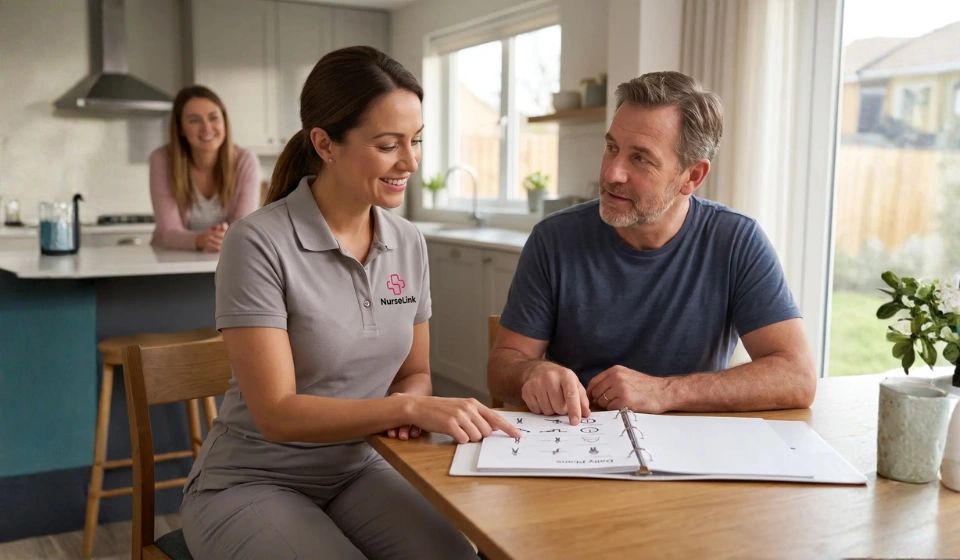
The initial conversation NurseLink Healthcare had with the family involved the husband, the daughter and, for the parts of the conversation she was able to engage with comfortably, the wife herself. It was, the care coordinator later noted, a conversation that required careful handling, because the husband’s guilt about needing help at all was, if anything, a bigger obstacle than any practical logistics.
He was direct about this, in his own way. He said he had made a promise to his wife many years ago that he would look after her, and that accepting outside help felt, to him, uncomfortably close to breaking that promise, even though he understood intellectually that it was not the same thing at all. The care coordinator did not try to argue him out of the feeling. She acknowledged it directly, and reframed the support being discussed as something that would let him keep the promise for longer and more sustainably, rather than something that replaced it.
Practically, the family needed support with his wife’s personal care several mornings a week, enough to give him a genuine and reliable block of time to attend to his own health, his own appointments and, eventually, some of the small things that had made up his own life before her diagnosis. They needed a support worker experienced with dementia care, patient with the specific communication needs that moderate dementia can involve, and capable of building a rapport with his wife gently enough that the transition did not distress her.
And, though it took him longer to say clearly, he needed to be told, by someone other than his own daughter, that accepting help was not a failure of devotion but a way of protecting the thing he was devoted to. The care coordinator made a point, in that first conversation, of saying this to him plainly, because she judged, correctly, that he needed to hear it from someone with professional standing on the matter.
The NurseLink Healthcare Solution
A Support Worker Chosen For Patience And Warmth With Dementia Clients
NurseLink Healthcare assigned a support worker with substantial dementia care experience, chosen specifically for her calm, unhurried manner and her demonstrated skill in building trust gently with clients who could find new faces and new routines disorienting. Before the first visit, she was briefed thoroughly on the wife’s communication preferences, her routines and the specific things that tended to reassure or, conversely, unsettle her.
The support worker was also briefed, just as importantly, on the husband’s situation, so that she understood from the outset that part of her role in this engagement was making the transition easy enough, and reassuring enough, that his guilt about stepping back did not undermine the arrangement before it had a chance to take hold.
Introducing Support Gradually, On The Wife's Terms
The first few visits were kept deliberately low-key, with the husband present for parts of them initially, so his wife could see him comfortable with the new person in the house before the visits shifted to a more independent footing. The support worker spent time simply sitting with her, talking about ordinary things, her garden, her children, memories from further in the past that were often more accessible to her than recent events, before introducing any of the personal care tasks that were the practical purpose of the visit.
This gradual approach paid off. Within a few weeks, the wife had become comfortable enough with the support worker’s presence that mornings together, including the personal care component, proceeded calmly and without the distress that a more abrupt introduction might have risked.
Personal Care That Preserved Her Dignity And Routine
The support worker managed showering, dressing and morning routines with a consistent, familiar structure each visit, understanding that predictability mattered enormously for a client living with dementia. She learned her preferences, her particular way of wanting things done, and matched them closely, which both reduced distress for the wife and reassured the husband that the standard of care matched what he had been providing himself.
Genuine Space For The Husband To Step Back Into His Own Life
With the mornings covered several days a week, the husband began, cautiously at first and then with growing confidence, reclaiming small pieces of his own life. He returned to his GP and addressed the blood pressure concern that had caused his collapse. He returned, eventually, to his weekly golf game, something his daughter later described as one of the most emotional developments of the entire engagement, given how long it had been since her father had done anything purely for himself.
The support worker made a point, in her handover conversations with him, of reassuring him specifically about how the visits had gone, not only clinically but in terms of his wife’s mood and comfort, understanding that this reassurance was as important to the arrangement’s success as the care itself.
Outcomes And Impact
His Health Stabilised
The husband’s blood pressure, once properly monitored and managed through his renewed engagement with his GP, returned to a safer range within a couple of months, and he did not experience a repeat of the collapse that had prompted the family’s initial contact with NurseLink Healthcare. His GP noted, at a review appointment, that the reduction in his caregiving load had been a material factor in both his physical health and his general demeanour.
She Remained Comfortable, Settled And Well Cared For
His wife’s dementia symptoms did not worsen at a rate beyond what would ordinarily be expected, and her carers, both her husband and her support worker, reported that she remained settled, comfortable and recognisably herself throughout the engagement, without the distress that a poorly managed transition to outside support might have caused.
He Became Her Husband Again, Not Just Her Carer
Perhaps the most significant outcome of the engagement, and the one the family returned to repeatedly in review conversations, was the shift in what the husband’s role in the marriage became able to include. With personal care tasks supported several mornings a week, he found himself with the time and energy to simply spend time with his wife again in ways that were not about managing a task, sitting with her, talking with her, being present with her rather than only attending to her.
His daughter described this shift, at a family review call, as giving her parents back something she had feared was gone for good, the simple, unhurried companionship that had defined their marriage for nearly six decades before dementia and exhaustion had crowded almost all of it out.
A Family That Worried Less
The couple’s children, who had watched their father’s health and spirits decline over the preceding two years with increasing alarm, reported feeling considerably more at ease once the arrangement was established, both about their mother’s day to day care and, just as importantly, about their father’s own wellbeing.
A Reflection From The Husband
Several months into the engagement, he shared the following with the NurseLink Healthcare care coordinator:
“I thought accepting help meant I was giving up on the promise I made her all those years ago. What I have learned is the opposite is true. I was so tired I was becoming someone I did not recognise, and I was not able to just be with her anymore, only manage her. Now I have my mornings for myself and my afternoons for us. I sat with her in the garden yesterday for an hour with nothing to do but talk. I had forgotten how much I missed that. I am playing golf again. My blood pressure is under control. And I get to be her husband again, not just the person managing her care.”
Key Takeaways From This Case Study
Homecare for a person living with dementia is also, inseparably, care for their carer. A spousal carer’s health and capacity to sustain their role over the long term are directly protected by the outside support that reduces their daily load, and this protection is as clinically significant as the direct care the client receives.
Guilt is often the real barrier to accepting help, not logistics. Carers who resist support are frequently protecting a sense of duty or promise rather than objecting to the practical arrangement itself. Addressing that guilt directly and respectfully is often the necessary first step before any practical plan can succeed.
A gradual, client-led introduction reduces distress for dementia clients significantly. Allowing the client to build comfort with a new support worker at her own pace, with her existing carer present initially, produces a smoother and more sustainable transition than a more abrupt handover.
Reclaiming a relationship, not just delegating tasks, is often the deepest outcome homecare can provide. The most meaningful shift in this engagement was not a reduction in workload alone, but the space it created for a husband and wife to be, once again, simply husband and wife.
Conclusion
Caring for a partner living with dementia is one of the most demanding roles a person can take on, and it is one that, without support, can quietly erode the health and wellbeing of the very person trying hardest to help. For the couple at the centre of this case study, NurseLink Healthcare provided homecare support that protected both of them, giving a devoted husband back his health, his own life in small but meaningful pieces, and the chance to simply sit with his wife in the garden again, with nothing left to manage.
If you or someone you love is carrying the weight of caring for a partner largely alone, we encourage you to reach out to the NurseLink Healthcare team. Support is not a break in the promise you made. It is what makes it possible to keep.
Latest Post
More Than Domestic Support
Still Her Home
The Weight She Was Carrying
Caring For Her Without Losing Himself
Managing Diabetes Without Sight
The Recovery Nobody Predicted
Finding Their Footing Again
On His Own Terms
When MS Moves In, The Whole Family Feels It
The Nurse Who Became The Patient
His Land, His Terms
Coming Home Differently
The Caregiver’s Pause
Still Going Home
Where He Belonged
Caring For Dad From Across The Country

Raising Three Kids While Living with Parkinson’s
A Family In Crisis. A Care Team Ready.
Homecare Cleaning Support
A Journey Of Comfort & Independence Through Homecare Support

Margaret’s Journey