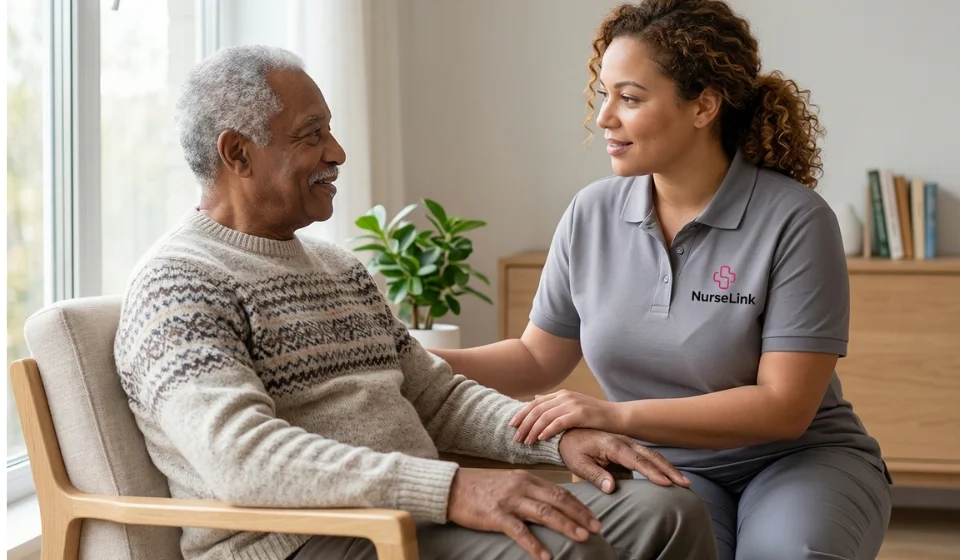
Carrying More Than He Could Carry
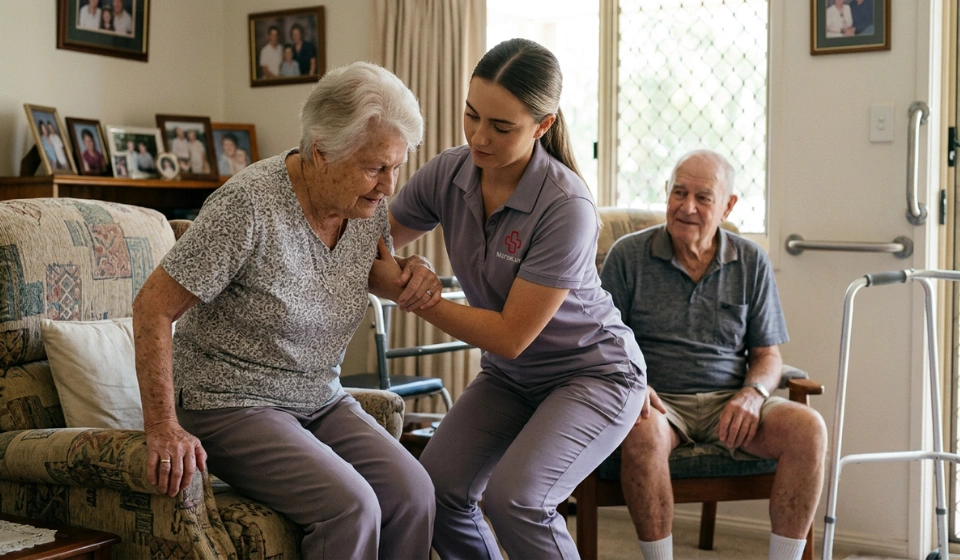
How NurseLink Supported A Husband Caring For His Wife's Worsening Arthritis
A Case Study In Homecare That Gave A Marriage Back Its Balance
Introduction
Severe arthritis rarely announces itself as an emergency. It arrives gradually, joint by joint and year by year, and the people caring for a spouse living with it tend to adjust just as gradually, taking on one more task here, one more piece of physical support there, until the accumulated weight of what they are managing has become considerably heavier than either of them quite realised, because no single addition to the load ever felt, on its own, like the moment things had changed.
For a husband caring for a wife whose mobility has slowly and significantly declined, this gradual accumulation carries a particular physical toll that is easy to overlook precisely because it has crept up so slowly. Lifting, supporting, assisting with transfers and personal care, done daily over months and years, takes a genuine physical toll on a carer’s own body, especially when that carer is himself no longer young, and the toll often goes unaddressed until something forces the issue, an injury, an illness, or simply a body that has finally had enough of carrying more than it was ever really built to carry.
This case study documents how NurseLink Healthcare supported a couple in their late seventies in Brisbane, after the husband, who had spent several years managing an increasing share of his wife’s physical care as her arthritis worsened, began to show the physical strain of a role that had grown well beyond what either of them had ever consciously decided he would take on.
To protect the privacy of the couple, all names and identifying details have been kept confidential throughout this case study.
The Couple & Their Situation
The husband and wife had been married for fifty-two years and lived in the same home in Brisbane’s western suburbs for most of their marriage. He had worked in local government before retiring in his mid-sixties, and she had raised their three children while working part time as a nurse, a career that had given her, in earlier decades, a certain wry appreciation for exactly the kind of care she now found herself needing rather than providing.
Her arthritis had been present in a manageable form for many years before it began, around four years before NurseLink Healthcare became involved, to worsen significantly, affecting her hips, knees and hands in ways that steadily reduced her mobility and her capacity to manage personal care tasks independently. The decline had been gradual enough that neither she nor her husband had marked a clear moment when their arrangement shifted from an ordinary marriage with some extra help here and there into something considerably closer to a full caring relationship, with him providing physical assistance for showering, dressing, transfers in and out of bed and chairs, and most of the household’s physical tasks that her joints could no longer manage.
He had taken this on, as he told the care coordinator during the initial assessment, without ever really deciding to, simply doing more as she was able to do less, in the way a devoted spouse tends to across a long marriage. What neither of them had properly accounted for was the physical cost to him of the lifting and supporting involved, particularly the repeated assistance with transfers that had become a daily, sometimes several-times-daily, part of his routine.
The issue came to a head when he strained his back significantly while helping her out of the bath one evening, an injury that left him in considerable pain and, for several days, unable to provide the physical support she had come to rely on entirely from him. Their daughter, called in urgently to help manage the gap, was alarmed both by her mother’s sudden lack of support and by the state her father was in, having clearly been managing far more physically than she had realised, and having said very little about it to anyone in the family until his own body had effectively forced the issue.
Understanding What The Family Actually Needed
The initial assessment conversation, involving both husband and wife along with their daughter, required the care coordinator to navigate two related but distinct sets of needs, his wife’s genuine physical care requirements, and his own physical limitations, which had clearly been exceeded for some time before the injury made the situation impossible to continue ignoring.
His wife needed support with showering, dressing and safe transfers, delivered by someone with proper training in assisting a person with significant joint restriction and pain, support that would reduce the physical demand that had been falling on her husband while maintaining the dignity and comfort she valued in how her care was provided. She was candid, in the conversation, that she had noticed her husband struggling for some time and had felt increasingly guilty about the physical burden she recognised she was placing on him, a guilt that had, if anything, made her reluctant to raise the issue directly for fear of making him feel he had failed in some way by needing outside help.
He, for his part, needed the physical load taken off him in a way that let him remain genuinely involved in his wife’s care and daily life without being the one providing every piece of physical support himself. He was clear that he did not want to become simply a bystander in his wife’s care, a role he suspected outside help might reduce him to if it was not handled thoughtfully, but he was equally clear, once his back injury had made the reality unavoidable, that he could not continue providing the level of physical assistance he had been providing without risking a more serious injury to himself.
Their daughter added a further, practical concern. She needed reassurance that whatever arrangement was put in place would actually hold, given how reluctant both her parents had been to acknowledge the strain building for years before it finally became impossible to ignore, and given her own worry about what would happen to both of them if her father’s back injury turned out to be more serious or more lasting than the initial assessment suggested.
The NurseLink Healthcare Solution
A Support Worker Trained Specifically In Safe Transfers & Joint Care
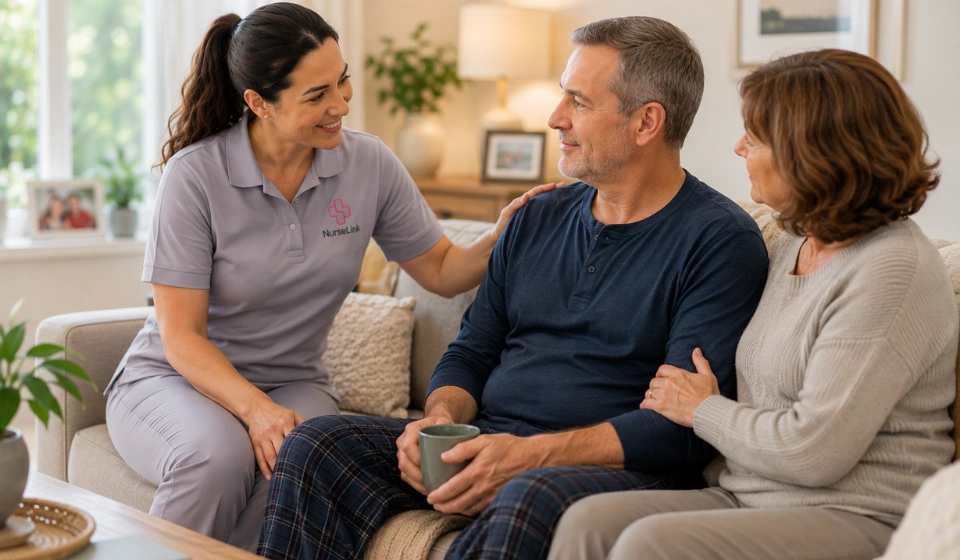
NurseLink Healthcare assigned a support worker with specific training and experience in supporting clients with significant arthritis and mobility restriction, chosen for both her technical competence in safe manual handling and transfer techniques and a warm, respectful manner suited to a couple navigating a genuinely sensitive transition in how their marriage’s caring roles worked. Before the first visit, she was briefed thoroughly on the wife’s specific joint restrictions, her pain patterns and comfort preferences, and the family’s broader context, including the husband’s recent injury and his stated wish to remain genuinely involved in his wife’s care rather than stepping back from it entirely.
Taking The Physical Load Off Him Without Taking Him Out Of The Picture
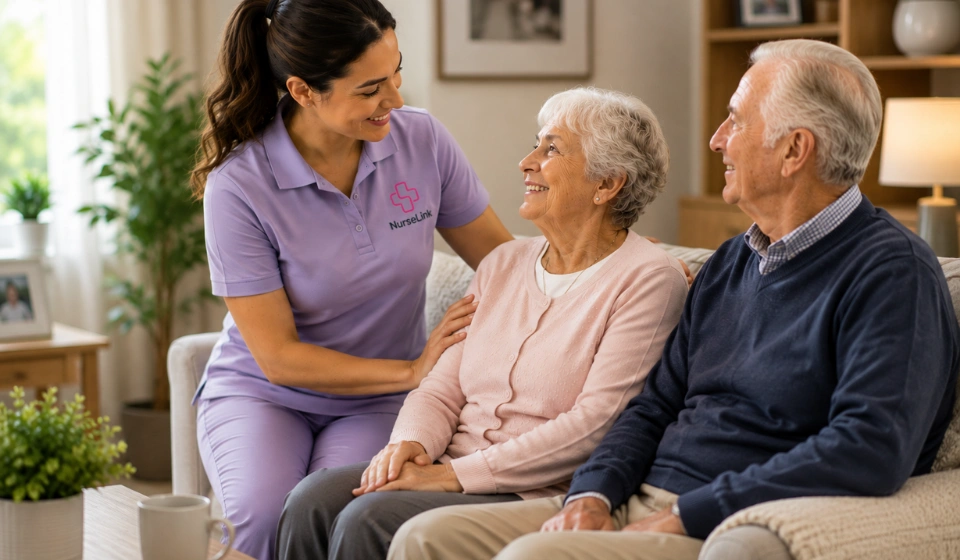
The support worker managed showering, dressing and transfer assistance using proper technique and appropriate equipment, immediately reducing the physical strain that had previously fallen entirely on the husband. Crucially, she structured the visits in a way that kept him genuinely involved, present during the sessions where he wanted to be, contributing to decisions about his wife’s comfort and preferences, and available to spend time with his wife in ways that were no longer defined primarily by physical exertion.
His wife noted, within the first few weeks, that this shift changed something meaningful about their time together. Where their interactions had increasingly become organised around the physical tasks of her care, transfers, dressing, showering, they began, once these tasks were properly and safely managed by someone else, to have more ordinary time together again, conversation, companionship, the parts of a fifty-two year marriage that had been gradually crowded out by the accumulating physical demands of her condition.
Addressing The Guilt On Both Sides
The support worker, recognising early in the engagement the guilt each of them carried, his wife’s guilt about the burden she felt she had placed on him, and his own quiet reluctance to have asked for help sooner, addressed this gently but directly in conversation with both of them, reframing the arrangement clearly as one that protected both of their wellbeing rather than representing any kind of failure on either of their parts. This reframing, according to their daughter’s later account, appeared to genuinely ease a tension in the household that had been present, largely unspoken, for some time before NurseLink Healthcare became involved.
Supporting His Own Recovery Alongside Hers
The care coordinator, aware of his back injury, encouraged him directly to use the time and physical relief the arrangement provided to properly attend to his own recovery, seeing his own GP and physiotherapist as needed rather than pushing through his own injury the way he had evidently been pushing through the accumulating physical demands of caregiving for years beforehand. He took up this encouragement, attending physiotherapy sessions across the following weeks that allowed his back to recover properly rather than being reinjured through continued strain.
A Household Finding A New, Sustainable Balance
As the weeks progressed, the household settled into a rhythm that both of them described, separately, as more sustainable and, in its own way, more genuinely companionable than the pattern that had developed in the years before the arrangement began. Physical care was handled safely and competently by someone properly trained for it, while the couple’s own time together was freed to be about each other again, rather than organised primarily around the physical demands her condition had come to require.
Outcomes And Impact
His Back Recovered Fully
With the physical demands of daily transfers and personal care support removed from his routine and proper physiotherapy support in place, his back injury resolved fully over the following weeks, and his physiotherapist confirmed, at his final review appointment, that he had recovered without any lasting damage, a genuinely fortunate outcome given how significantly he had been straining himself in the period before the injury forced a change.
Her Care Was Delivered Safely & Comfortably
His wife’s showering, dressing and transfer needs were met consistently and safely throughout the engagement, delivered with the proper technique and equipment that reduced both her discomfort during these tasks and the physical risk that had previously been present when her husband, however devoted, was managing them without proper training.
Their Marriage Found More Room For Itself
Perhaps the most significant outcome of the engagement, in both their own accounts, was the space it created for their marriage to be about more than caregiving again. Both described, separately, valuing the return of ordinary conversation and companionship that the accumulating physical demands of her condition had gradually crowded out over the preceding years, a shift their daughter noticed clearly during her own visits, describing her parents as seeming, for the first time in a long while, like a couple enjoying each other’s company rather than simply managing a difficult situation together.
Guilt Gave Way To Genuine Relief
Both husband and wife reported, at a review conversation some months into the engagement, that the guilt each had privately carried, hers about the burden she felt she had placed on him, his about not having asked for help sooner, had substantially eased once the arrangement was properly established and both could see, plainly, how much better it was working for both of them.
A Family Reassured
Their daughter, whose initial concern had prompted the family’s engagement with NurseLink Healthcare, reported feeling considerably more at ease about both her parents’ wellbeing once the arrangement was established, describing the peace of mind of knowing her mother’s care was being properly and safely managed and her father was no longer carrying a physical burden that had, by the time of his injury, clearly exceeded what his own body could sustainably bear.
A Reflection From The Husband
Several months into the engagement, he shared the following with the NurseLink Healthcare care coordinator:
“I never decided to take on as much as I had. It just built up, year by year, until my back finally told me what I had not been willing to admit myself. I was frightened that getting help would mean stepping back from looking after my wife, and that is not what happened at all. I am still very much part of her care and her days. I just am not the one lifting her in and out of the bath anymore, which my back is considerably happier about. And honestly, my wife and I talk more now than we have in years, because we are not always in the middle of some physical task when we are together. That was not something I expected help to give us, but it might be the thing I am most grateful for.”
Key Takeaways From This Case Study
Caregiver physical strain builds gradually and is easy for both the carer and the family to underestimate. A spouse taking on increasing physical care over years, without any single dramatic moment marking the shift, can reach a genuinely unsustainable level of physical demand well before anyone, including the carer himself, properly recognises it.
Removing the physical burden of care does not have to mean removing the carer from the caring relationship. Support that takes over the physically demanding tasks while deliberately keeping the spouse genuinely involved protects both his body and his role in his partner’s life and care.
Guilt on both sides of a caring relationship needs to be addressed directly. Both members of this couple carried unspoken guilt about the arrangement’s strain, and naming and reframing that guilt directly helped ease a tension that had been present in the household for some time.
Reducing the physical task load can restore the relational quality of a marriage strained by caregiving. With physical care safely managed by trained support, this couple recovered time and space for ordinary companionship that the accumulating demands of her condition had gradually crowded out.
A carer’s own recovery deserves direct attention, not just encouragement in passing. Actively supporting the husband’s own physiotherapy and recovery, rather than assuming he would manage it himself once his caregiving load reduced, helped ensure his back injury resolved fully rather than recurring under continued strain.
Conclusion
A devoted spouse can, without ever quite deciding to, take on a physical caring burden that gradually exceeds what his own body can sustainably manage, and it often takes an injury or a crisis to make that unsustainable weight visible. For the couple at the centre of this case study, NurseLink Healthcare provided homecare support that lifted the physical load safely off a husband whose back had finally reached its limit, while keeping him genuinely present in his wife’s care and, in the process, giving their marriage back some of the ordinary time together that years of accumulating physical demands had quietly crowded out.
His back has healed. Her care is safe and comfortable. And most evenings now, instead of managing a transfer, they are simply sitting together, talking, the way they always used to before arthritis and years of accumulating strain got in the way.
If you or someone you love is carrying more of a caring role than your own body can sustainably manage, we encourage you to reach out to the NurseLink Healthcare team. Support does not have to mean stepping back from caring for someone you love. It can simply mean giving your own body room to keep going.
Latest Post
More Than Domestic Support
Still Her Home
The Weight She Was Carrying
Caring For Her Without Losing Himself
Managing Diabetes Without Sight
The Recovery Nobody Predicted
Finding Their Footing Again
On His Own Terms
When MS Moves In, The Whole Family Feels It
The Nurse Who Became The Patient
His Land, His Terms
Coming Home Differently
The Caregiver’s Pause
Still Going Home
Where He Belonged
Caring For Dad From Across The Country
Raising Three Kids While Living with Parkinson’s
A Family In Crisis. A Care Team Ready.
Homecare Cleaning Support
A Journey Of Comfort & Independence Through Homecare Support
Margaret’s Journey