Coming Home Differently
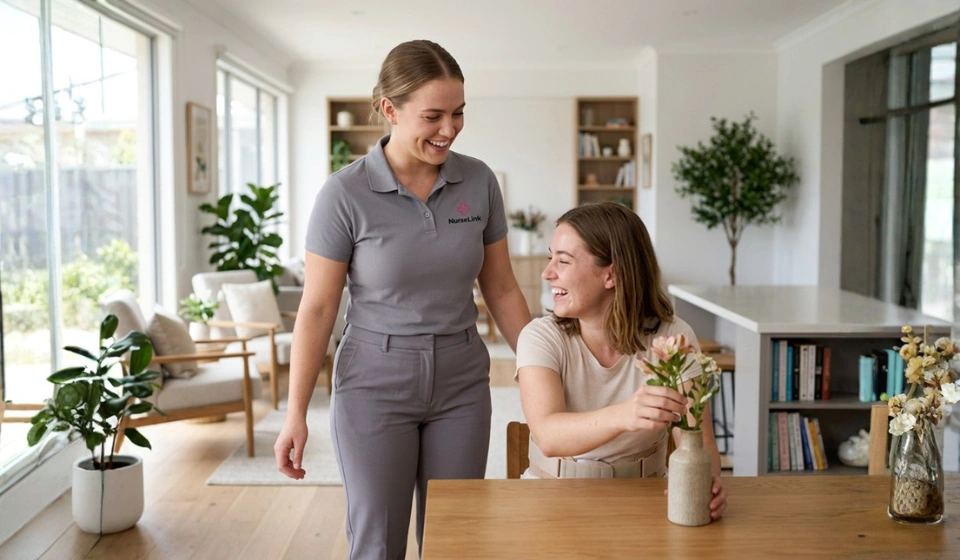
How NurseLink Supported A Young Woman With A Spinal Injury
A Case Study In Transitional Homecare For A Young Person Rebuilding Life After A Life-Changing Injury
Introduction
There is a particular kind of courage required to leave a rehabilitation hospital. The ward, for all its clinical sterility, has become familiar. The routines are known. The nurses know your name, your preferences, your rhythms. Help is always close. And then comes the day when the discharge papers are signed, the car is waiting at the entrance, and a person who has spent months learning how to exist in a completely new body is asked to do that in the place they used to call home, which now looks and feels entirely different from the inside.
For a young person, the transition from hospital to home following a serious spinal injury carries a weight that is difficult to fully articulate. It is not simply a clinical event. It is the beginning of a new chapter of life that was never planned for, arriving at an age when the plans were supposed to be about something else entirely. The future that existed before the injury must be reimagined. The home that was once effortless must be relearned. And the people who love that person most, parents, siblings, friends, must find a way to be present and supportive without the clinical knowledge to know what helping actually looks like.
Homecare following spinal injury, when it is built with genuine understanding of what a young person in this situation actually needs, can be the thing that makes the difference between a transition that is survivable and one that is genuinely good. At NurseLink Healthcare, we understand the complexity and the tenderness of this moment, and we build our support around both.
This case study documents how our team supported a woman in her early twenties in Geelong, Victoria, through the first months at home following a spinal injury sustained in a recreational accident, at a point when the gap between what she needed and what her family alone could provide was significant.
To protect the privacy of the client and her family, all names and identifying details have been kept confidential throughout this case study.
The Client & Her Situation
The client is a woman in her early twenties who had been living independently in Geelong, sharing a house with friends and working in the hospitality industry, when a recreational accident during a weekend trip resulted in a spinal injury that changed the course of her life entirely. The injury left her with incomplete paraplegia, meaning she retained some sensation and limited movement in her lower limbs but required a wheelchair for mobility and was dependent on assistance for a significant range of daily tasks she had previously managed without a second thought.
She spent several months in a spinal rehabilitation unit following her acute hospital stay, working with physiotherapists, occupational therapists and specialist spinal nurses to understand her injury, develop her functional capacity and prepare for discharge. The rehabilitation team had done excellent work. By the time discharge was being planned, she had made real progress. She was motivated, determined and had a realistic understanding of what her life at home was going to require.
What she was returning to, however, was not the independent share house she had left. Her parents, who lived in Geelong and with whom she had maintained a close relationship despite living separately, had prepared their home for her return. Modifications had been made. A hospital grade bed had been organised. The family had done everything they could to be ready.
But her parents, both working full time and without any clinical background, were facing the reality of supporting a daughter with complex care needs that neither of them had been trained for. The spinal rehabilitation team, reviewing the discharge plan, identified a significant gap between what the family could realistically provide and what she needed, particularly in the early months when her care requirements were most intensive and the routines of managing her injury at home were still being established.
A referral to NurseLink Healthcare followed.
Understanding What She Actually Needed
The initial assessment NurseLink Healthcare conducted was one that the client herself led with considerable clarity. She was young, she was articulate and she had spent months in rehabilitation thinking carefully about what her life at home needed to look like. She had views, and she expressed them directly.
She did not want to feel like a patient in her parents’ home. She had already spent months being a patient. What she wanted was support that helped her be as independent as possible within her current functional capacity, that treated her as an adult making decisions about her own life and that did not hover or infantilise or assume that a spinal injury had also affected her judgment or her personality. She wanted support workers who would take their lead from her, not the other way around.
She was specific about the clinical side of care as well. Bowel and bladder management following spinal injury is a significant and complex clinical requirement, and she needed support workers who were trained in this area and could provide that care without making her feel diminished by needing it. Skin integrity monitoring was essential, as pressure injuries represent a serious risk for wheelchair users and early identification of any concern needed to be built into every visit. Her medication regime and the monitoring of her general health in the context of her injury also required clinical attention.
Her parents, in their own conversation with the NurseLink Healthcare care coordinator, were honest about what they needed too. They needed to know that the clinical aspects of their daughter’s care were genuinely covered, because the fear of getting something wrong, of missing a sign of a pressure injury developing or mismanaging a clinical situation they did not understand, was sitting heavily on them both. They needed guidance on how to be helpful without taking over. And they needed, on some days, for someone else to be the person in the room so that they could simply be her parents.
The NurseLink Healthcare Solution
Support Workers Selected For Both Clinical Skill & Personal Fit
NurseLink Healthcare’s selection process for this engagement gave equal weight to clinical capability and personal compatibility. The support workers placed needed to have specific experience in spinal injury care, including proficiency in bowel and bladder management protocols, skin integrity assessment and the safe management of a wheelchair user’s daily care needs. These were non-negotiable clinical requirements.
But they also needed to be people who would work well with a young woman in her early twenties who was determined to maintain her autonomy and her sense of self through a period that had the potential to strip both away. Support workers who were warm without being patronising, clinically competent without being clinical in their manner and willing to take direction from a client who knew her own mind were what this engagement required.
The introductory visit, where she met the support workers proposed for her roster before any care formally commenced, was designed around her comfort rather than administrative convenience. She had the opportunity to ask her own questions, to get a sense of the people who would be coming into her home and to indicate whether she felt the fit was right. Her feedback shaped the final roster.
Daily Care Built Around Her Independence Goals
The care plan NurseLink Healthcare developed was structured explicitly around maximising her independence rather than managing her dependency. Every care task was approached with the question of what she could do, or could be supported to do with minimal assistance, rather than what needed to be done for her. On days when her energy and function were good, more independence was given. On harder days, more support was provided. The care moved at her pace and responded to her, rather than following a fixed script regardless of how she was actually doing.
Morning care routines, which for a person with her level of injury are both clinically significant and deeply personal, were delivered with the efficiency of people who knew what they were doing and the sensitivity of people who understood what they were part of. She was involved in every decision about her own care and was never made to feel that her body was being managed rather than supported.
As the weeks progressed and her confidence and routine at home became more established, the care plan was reviewed and adjusted to reflect her growing independence in certain areas. Support that had been necessary in the first weeks became less necessary as she developed her own strategies and capacity, and NurseLink Healthcare adjusted accordingly.
Clinical Monitoring That Protected Her Health
Skin integrity monitoring was incorporated as a non-negotiable element of every visit. Support workers were trained in the specific pressure injury risk factors associated with her injury level and mobility profile, and any concern identified during a visit was documented, communicated to her and escalated to her community nurse and GP as required. Throughout the engagement, no pressure injury developed. That outcome, which can never be taken for granted in the management of a spinal injury at home, reflected the consistency and attentiveness of the monitoring that was in place.
Her bowel and bladder management programme, established during her rehabilitation admission, was maintained with the clinical consistency that its effectiveness depended upon. NurseLink Healthcare’s support workers were briefed thoroughly on her specific programme and followed it with the precision her rehabilitation team had recommended, maintaining close communication with her outpatient spinal team to ensure any adjustments were made appropriately.
Supporting Her Parents To Be Her Parents
One of the most significant elements of NurseLink Healthcare’s involvement was the effect it had on the family dynamic in the household. Her parents, who had been bracing for the responsibility of managing their daughter’s clinical care on top of their own working lives, found that the presence of NurseLink Healthcare’s support workers gave them something they had not expected to have so readily. Permission to step back from the clinical role and be present in a different way.
The care coordinator maintained regular contact with her parents, explaining what was being done and why, answering the questions they had been afraid to ask and giving them a clear and honest picture of how their daughter was managing. The fear of missing something clinically important, which had been a constant source of anxiety, diminished as trust in the NurseLink Healthcare team grew.
Her mother described, several weeks into the engagement, an evening where she and her daughter had watched a film together and laughed and talked in the way they always had before the accident, without the undercurrent of clinical anxiety that had coloured most of their interactions since the discharge. It was, she said, the first time she had felt like her daughter’s mother rather than her daughter’s carer.
Outcomes & Impact
She Settled At Home Successfully
The transition from rehabilitation hospital to home, which had been the source of significant anxiety for the whole family in the weeks before discharge, was managed without crisis, without clinical incident and with a gradual but genuine sense of stability establishing itself over the first weeks. She did not need to be readmitted. The care plan held. And the home that had seemed so uncertain a prospect before discharge became, over the months that followed, the place where her recovery continued to progress.
Her Independence Grew Progressively
Over the course of the engagement, her functional independence in a range of daily tasks increased meaningfully. Some of this was the natural progression of her rehabilitation continuing at home. But the structured, goal-oriented approach of NurseLink Healthcare’s support, which consistently pushed toward independence rather than managing dependency, contributed directly to the pace at which that progress happened. By the later months of the engagement, there were areas of her daily routine that she was managing entirely independently that had required full support in the earliest weeks.
Her Physical Health Remained Protected
The clinical monitoring built into every visit produced the outcome it was designed to produce. No pressure injuries developed. Her bowel and bladder management programme ran consistently. Her medication management was reliable. And the early identification of a urinary tract infection, a common and potentially serious complication for people with spinal injuries, during a routine visit allowed prompt treatment before it became a significant health event.
The Family Found Its New Shape
Perhaps the most quietly significant outcome of the engagement was the one that was hardest to measure but easiest to see. The family, which had been holding itself in a state of sustained tension since the accident, began to find the shape of its new normal. Her parents stopped feeling solely responsible for their daughter’s clinical safety. She stopped feeling like a burden in her own parents’ home. And the relationships that mattered most to all of them had room to be themselves again, not just arrangements built around managing an injury.
A Reflection From The Client
Several months into the engagement, she shared the following with the NurseLink Healthcare care coordinator:
“I was terrified of coming home. I thought it was going to feel like giving up, like admitting that my old life was really gone. What I didn’t expect was that having the right support around me would actually make me feel more like myself, not less. The NurseLink team treated me like a person with a plan, not a problem to be managed. That made all the difference.”
Key Takeaways From This Case Study
Transitional homecare for spinal injury requires clinical and personal precision. The clinical demands of supporting a person with a spinal injury at home are significant and specific. But the personal dimension of supporting a young person to rebuild their identity and independence after a life-changing injury is equally important. Homecare that addresses only one of these dimensions has addressed only half of what is needed.
Independence is a clinical goal, not just a personal preference. For a young person with a spinal injury, maximising functional independence is not simply about quality of life, though it matters enormously for that reason. It is about long-term health outcomes, psychological wellbeing and the sustainability of a life lived as fully as possible. A homecare plan built around independence goals produces better outcomes than one built around managing dependency.
Family members need support alongside the client. The parents, partners and siblings of a person who has sustained a serious injury are carrying an enormous amount. Homecare that provides clinical support for the client while leaving the family to manage their own anxiety, uncertainty and adjustment without guidance has missed a significant part of what makes a transition successful.
Skin integrity monitoring is not optional in spinal injury homecare. Pressure injuries represent one of the most serious preventable health risks for wheelchair users. Consistent, skilled monitoring at every visit is a clinical responsibility that cannot be deprioritised. NurseLink Healthcare’s approach treats it as the non-negotiable element of care that it is.
Conclusion
A spinal injury sustained in early adulthood asks a young person to do something that no one should have to do at any age — to rebuild an entire understanding of themselves, their body and their future, from the ground up, while still grieving the life that existed before.
Coming home for the first time after that injury is one of the hardest moments in that process. It is the point at which the protection of the hospital is left behind and the reality of the new life begins in earnest.
NurseLink Healthcare exists to make that moment as safe, as supported and as genuinely hopeful as it can be. We provided the clinical care this young woman needed, the independence-focused support her goals required and the family with the breathing room to be what she needed them to be.
If someone you love is facing the transition home after a serious injury or illness, and you are trying to understand what the right support looks like, we encourage you to reach out to the NurseLink Healthcare team. We would be honoured to help you find the way forward together.
Latest Post
Coming Home Differently
The Caregiver’s Pause
Still Going Home
Caring For Dad From Across The Country
Raising Three Kids While Living with Parkinson’s
A Family In Crisis. A Care Team Ready.
Homecare Cleaning Support
A Journey Of Comfort & Independence Through Homecare Support
Margaret’s Journey