Finding Their Footing Again
How NurseLink Healthcare Helped A Mother Living With Severe Osteoporosis
A Case Study In Homecare That Held A Whole Family Together While One Of Them Was Breaking Apart
Introduction
Osteoporosis is one of those conditions that most people have heard of and very few people fully understand until it arrives in their family. It is not dramatic in the way that a heart attack is dramatic or visible in the way that a stroke is visible. It is quiet and progressive and its consequences arrive without warning, a fracture from a movement that would not have registered as anything the year before, a vertebra that compresses under the ordinary weight of an ordinary morning, pain that does not resolve in the way that pain is supposed to resolve and that begins, over time, to shape every decision about how to move through a day.
For the person living with severe osteoporosis, the condition takes more than bone density. It takes confidence. The confidence of a person who once moved through the world without calculating every step is replaced by a vigilance that is exhausting and by a fear that is entirely rational, because the consequences of a fall are not a bruise and a fright but a fracture and a hospitalisation and a recovery that may not return everything it borrows.
For the family around that person, the condition takes something too. It takes the version of their mother or grandmother or wife that existed before the fear arrived and the pain became constant and the world outside the house began to feel less like a place she belonged to and more like a place that was waiting to hurt her again.
Homecare that understands all of this, that addresses the clinical management of a complex condition while also attending to the isolation and the fear and the family that is reorganising itself around a new reality, can be the thing that helps a family find the shape of a life that still works. At NurseLink Healthcare, we build our care around exactly this understanding. This case study documents how our team supported an elderly woman in Canberra, Australian Capital Territory, living with severe osteoporosis and multiple fractures, and the family that was trying, alongside her, to find a new normal.
To protect the privacy of the client and her family, all names and identifying details have been kept confidential throughout this case study.
The Client & Her Situation
The client is a woman in her late seventies who had lived in the same Canberra suburb for over forty years, in a house she and her late husband had moved into when their children were small and that she had remained in through widowhood and retirement and the gradual quieting of a life that had once been full of noise and people and the particular busyness of a woman who had always found it easier to be useful than to be still.
She had three adult children. A son who lived in Canberra, a daughter who lived in Sydney and a younger daughter who lived in Queensland. All three were closely involved in their mother’s life, visiting regularly and staying in frequent contact, and all three had been watching the progression of her osteoporosis with the particular anxiety of adult children who love their parent and cannot fix what is happening to her.
The osteoporosis had been diagnosed several years earlier and managed initially with medication and lifestyle modifications that had slowed but not stopped its progression. Over the preceding eighteen months, she had sustained three fractures, two vertebral compression fractures that had produced significant and persistent back pain, and a wrist fracture from a fall in the kitchen that had shaken her confidence in a way that the physical recovery had not fully restored. She moved carefully, which was necessary and which had the secondary effect of moving less, which was not good for her bones or her mood or her connection to the life she had always lived.
She had not left the house independently for several months. She had stopped hosting the monthly lunches she had been holding for a group of friends for years, because the preparation involved was too physically demanding and the fear of a fall with guests present was too present to manage alongside the hosting. She had, in the quiet way of a person who does not want to make a fuss, become smaller.
Her son, who visited most frequently by virtue of living in the same city, had noticed the change with the particular sharpness of someone who had known her all his life. The woman who had run a household and worked part time and driven her grandchildren to after-school activities was spending most of her days in her chair, in pain, managing the hours until her children called. He had raised the question of additional support with his sisters, and the three of them had together reached out to NurseLink Healthcare.
What The Family Was Navigating
The conversation the three siblings had with each other before they contacted NurseLink Healthcare was one that many families in this situation will recognise. The guilt of the two who lived interstate, who visited when they could and called often and knew that this was not the same as being there. The weight on the one who was there, who was doing more than the other two and felt the inadequacy of what more looked like against what was actually needed. The shared grief of children watching a parent become a smaller version of herself and not knowing how to help.
Their mother, for her part, was managing something that she did not fully name to any of them. She was frightened. Not dramatically, not in a way she would have described as fear, but in the persistent, low-level way of a person who has fallen and knows what falling costs and cannot stop thinking about it. Every movement contained a calculation. Every morning began with an assessment of how the pain was and what the day was therefore going to allow. And underneath all of it, the particular loneliness of a person who had always been surrounded by people and was now spending most of her days alone with her pain and her vigilance and the chair by the window.
She had not said any of this to her children because she did not want to worry them more than they were already worried. They had not said some of it to her because they did not want to make her feel like a burden. The family was managing its love for each other partly through the things it was not saying, which is a very human thing to do and not a very helpful one.
Understanding What She & Her Family Needed
The initial assessment NurseLink Healthcare conducted was one that began with her and stayed with her throughout, because she was the person at the centre of the arrangement and she had things to say that were worth hearing.
She was specific about the pain, which was present most days and which varied in intensity in ways that made some days manageable and others not. She was specific about the fear, which she named more directly in the assessment conversation than she had in any conversation with her children, perhaps because the care coordinator was a stranger and strangers are sometimes easier to be honest with. She said she was frightened of falling. She said she had stopped doing things she used to do because of it. She said she missed her friends and she missed her lunches and she missed feeling like herself, and she said it in the way of a person who has been waiting for someone to ask.
She also said something that shaped the care plan significantly. She did not want to feel managed. She had been a capable woman for most of her life and she intended to remain as capable as her condition allowed. She wanted support that helped her do things, not support that did things for her and left her sitting in her chair feeling observed.
Her son, who attended the assessment, added what she had not said about the family dimension. He was worried about his mother and he was also, honestly, managing a level of concern that was affecting his own daily life in ways he found difficult to talk about. His sisters were carrying their own versions of the same weight from a greater distance. The family needed to know that the clinical side of things was genuinely covered, not managed around the edges, so that the time they spent with their mother could be spent being her family rather than assessing how she was.
The NurseLink Healthcare Solution
Support Workers Who Understood Pain & Fear Equally
NurseLink Healthcare’s selection of support workers for this engagement gave equal weight to clinical knowledge of osteoporosis management and the personal qualities required to support a woman whose primary barriers were as much psychological as physical. The support workers assigned had experience with musculoskeletal conditions, falls prevention and pain management in elderly clients, and had the manner and the patience to work with a woman who needed to feel that her autonomy was being respected rather than overridden.
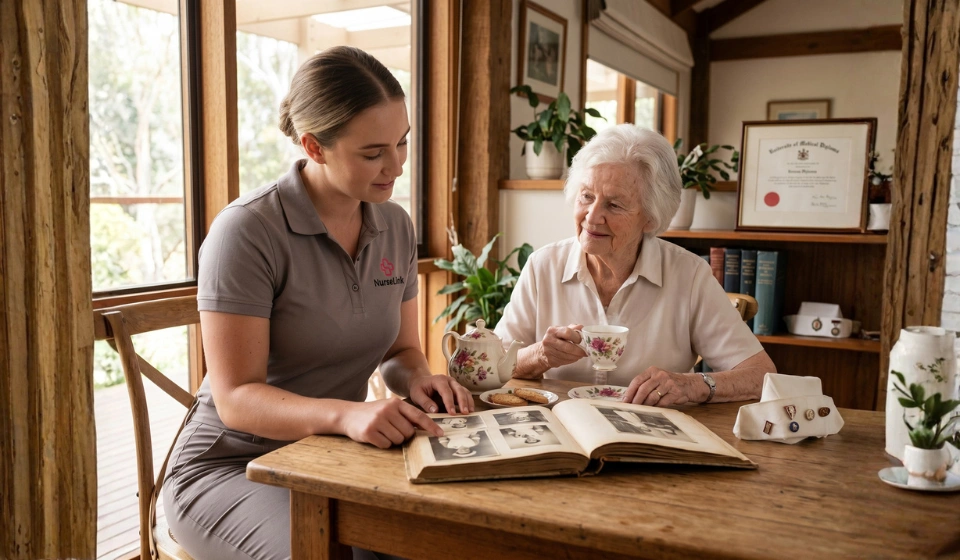
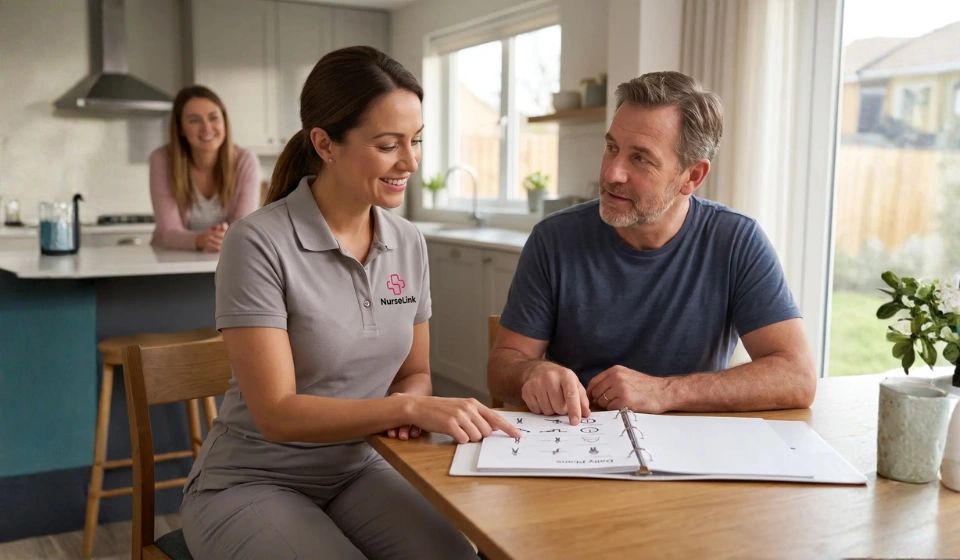
The introductory visit was conducted as a conversation rather than a clinical assessment, in the sitting room where she spent most of her days, with tea and without clipboards. The care coordinator and the primary support worker who would be working with her spent time getting to know her before they asked any clinical questions, because a woman who feels known is more likely to accept help than a woman who feels assessed.
By the end of the first visit, she had told them about the lunches she used to hold and about the friends she had been avoiding and about the garden she had stopped spending time in because the uneven path to it felt too risky. These were not incidental details. They were the map of what the care plan needed to work toward.
Pain Management Support Built Into Every Visit
Every visit incorporated structured pain assessment and management support, including monitoring of her pain levels against the baseline established at the outset of the engagement, support with the medication regime her GP had prescribed, positioning and mobility assistance that reduced the physical strain of daily activities on her spine and wrists, and the application of the gentle movement programme her physiotherapist had developed to maintain what bone and muscle strength remained.
Her pain was documented consistently and communicated to her GP, who used the information from NurseLink Healthcare’s visit records to adjust her management plan at several points across the engagement. The clinical visibility into her day to day pain levels that the visits provided gave her treating team information they had not previously had access to, because she had been, in her GP’s experience, inclined to underreport pain in clinical appointments rather than appear to be making a fuss.
Falls Prevention That Restored Rather Than Restricted
The falls prevention component of her care plan was developed with the explicit goal of reducing her fear of falling rather than simply reducing her exposure to the situations that carried falls risk. A falls prevention approach that removes risk by removing activity produces a person who is safer in the narrow clinical sense and more isolated, less confident and less physically capable in every other sense. NurseLink Healthcare’s approach was designed to avoid this outcome.
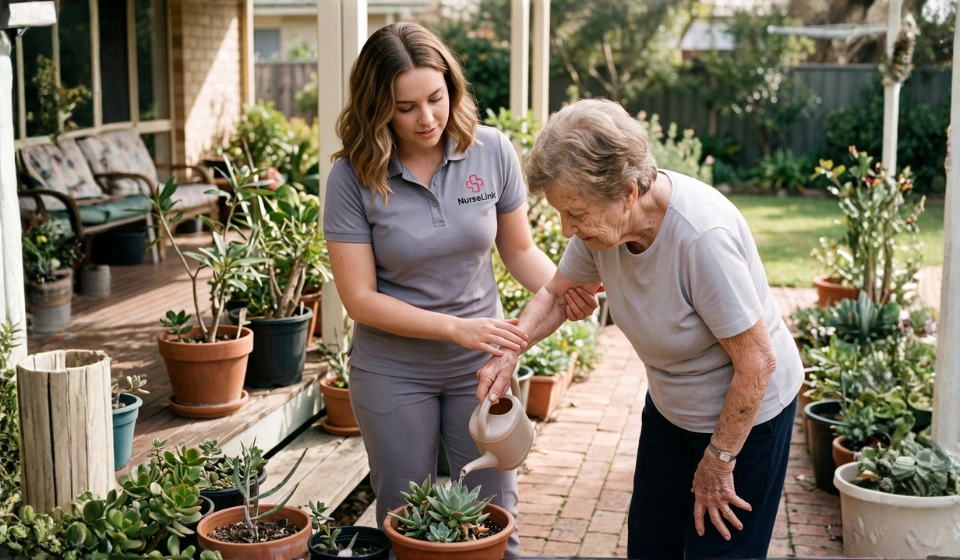
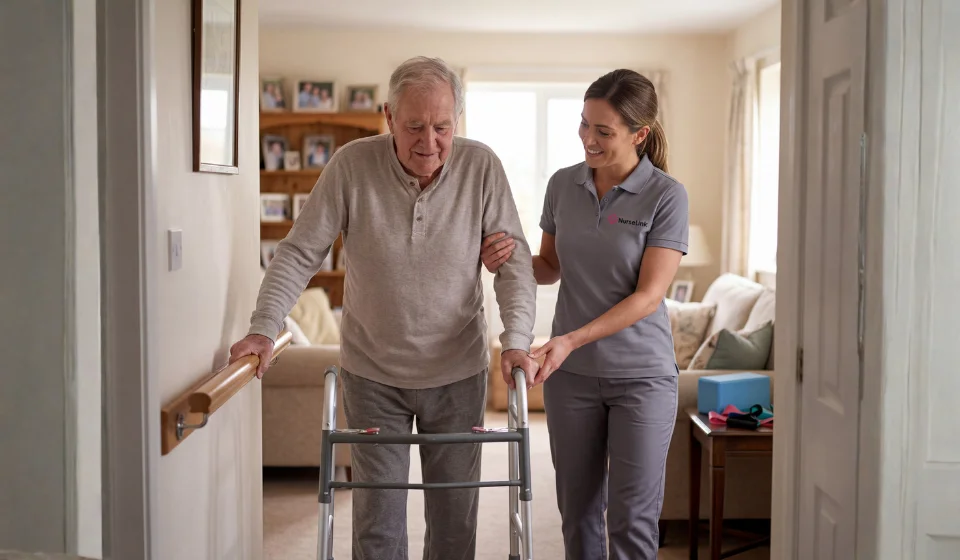
Her home environment was reviewed with her involvement and the modifications recommended were explained in terms of what they would allow her to do rather than what they would prevent. Grab rails that would allow her to use the bathroom independently were framed as independence tools rather than safety interventions. The path to the garden was addressed with a simple surface modification that, once in place, allowed her to return to the garden she had stopped visiting, which she did within the first fortnight.
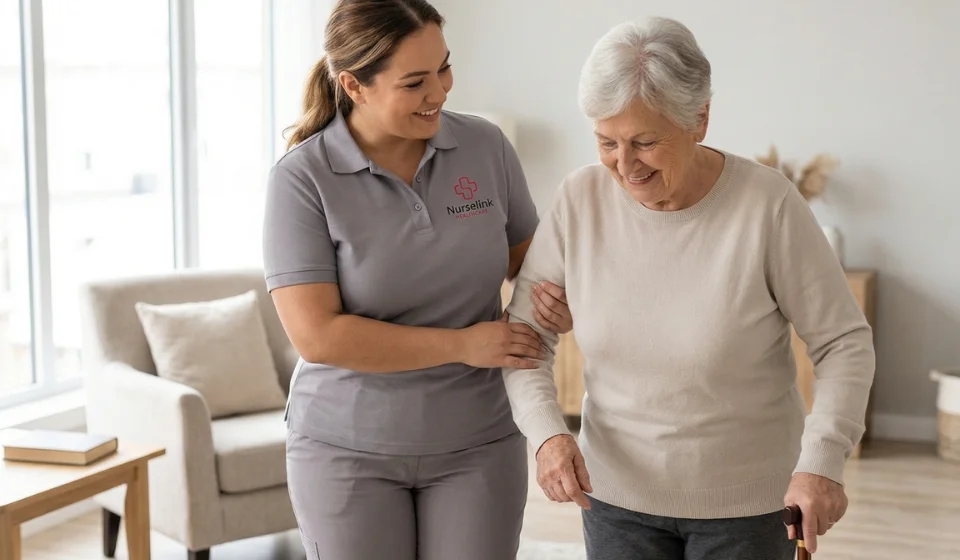
Her support workers accompanied her on the activities she had been avoiding, not as supervisors managing a risk but as companions making the activity possible, which is a different dynamic and one that she responded to differently. She began, across the weeks of the engagement, to do more of the things she had been doing less of. Not recklessly, but with the support that made doing them feel less frightening than not doing them.
Rebuilding Her Social Connection
The monthly lunches she had been hosting for years were something NurseLink Healthcare’s support workers identified early as a goal worth working toward, because the significance she attached to them went well beyond the social occasion itself. They represented the version of herself she missed most, the capable, generous woman who had a table full of people around her and was feeding them and looking after them and being, in the deepest sense of the word, herself.
Several weeks into the engagement, with support planning and preparation assistance from her primary support worker, she held a lunch for four friends for the first time in months. Her support worker was present throughout, managing the practical aspects of the preparation that were beyond her current physical capacity while allowing her to be the host, which was the role that mattered. Her friends came. They ate. They talked for three hours. She was exhausted afterward in a way that was entirely different from the exhaustion of pain and isolation. She was exhausted in the way of someone who has done something that mattered and knows it.
Keeping The Family Genuinely Informed
NurseLink Healthcare maintained regular communication with her son, who passed information to his sisters, through a structured update process that gave the family an accurate and specific picture of how their mother was managing across the engagement. The updates covered her pain levels, her activity and mobility, her emotional wellbeing and anything clinically notable that had been observed.
Her daughters, calling from Sydney and Queensland, found that their conversations with their mother changed across the months of the engagement. They had more to talk about, because she was doing more. The calls that had been dominated by their anxiety about her and her management of their anxiety were replaced, gradually, by calls that were about the lunch she had held and the garden she was spending time in again and the things she was thinking about. They were still worried. But they were also, increasingly, talking to their mother rather than to their worry about her.
Outcomes & Impact
Her Pain Was Better Managed & More Consistently Monitored
The structured pain assessment built into every visit, combined with the consistent documentation and communication with her GP, produced a level of clinical oversight of her pain management that translated directly into better management. Medication adjustments made on the basis of the visit data reduced her average daily pain levels across the engagement period. She was not pain-free, because severe osteoporosis does not offer that, but she was better managed than she had been before the engagement began, and she was managing her pain in the context of a life that had more in it than it had had in months.
She Left The House Again
The woman who had not left her home independently for several months was, by the sixth week of the engagement, leaving it regularly with support for short outings that her support worker accompanied her on. By the third month, she had attended a medical appointment, visited a friend’s home for the first time since her last fracture and returned to the garden that had been inaccessible to her for the better part of a year. These were not small clinical outcomes. They were the return of a life.
The Family Found Its New Shape
The three siblings, who had begun the engagement in different states of guilt, worry and practical exhaustion, found across the months of NurseLink Healthcare’s involvement that the presence of a reliable, skilled and genuinely caring support arrangement around their mother changed the texture of their relationship with her situation. The son in Canberra could visit without spending the visit assessing her clinical status. The daughters in Sydney and Queensland could call without the calls being entirely organised around their anxiety. The family had not stopped worrying, because she still had a serious condition and the worry that came with it was entirely reasonable. But the worry was no longer the whole of what they had with her.
She Felt Like Herself Again In The Ways That Mattered
The outcome that she returned to when the care coordinator checked in with her several months into the engagement was not the pain levels or the falls risk or the mobility improvements, though she acknowledged all of these. It was the lunch. She talked about the lunch she had held for her friends as the moment she had felt most like herself since the last fracture, and she said it with the quiet satisfaction of a person who has recovered something she was not sure she was going to get back.
A Reflection From Her Son
Several months into the engagement, her son shared the following with the NurseLink Healthcare care coordinator:
“Mum had become someone who was just managing her days. Getting through them. That is not who she is and it is not who any of us wanted her to be. What NurseLink did was help her become herself again, slowly and carefully and in a way that was right for her condition. My sisters and I can call her now and she has things to tell us. She had her friends over. She is in the garden. She is still in pain and she is still careful and she is also still our mum, which is the thing we were most afraid of losing. I cannot tell you what that means to us.”
Key Takeaways From This Case Study
Osteoporosis management requires attention to fear as well as fracture risk. A woman who has stopped living her life because she is frightened of falling has not been adequately supported by a care plan that addresses only the physical dimensions of her condition. NurseLink Healthcare’s approach held the fear as a clinical concern equal in importance to the pain and the fracture risk, and the outcomes reflected this.
Falls prevention should expand capability, not restrict it. A falls prevention strategy that reduces risk by reducing activity has misunderstood its own purpose. The goal is a person who is safer because they are stronger, more confident and better supported, not safer because they are doing less. NurseLink Healthcare’s approach to falls prevention was oriented toward what it would allow her to do rather than what it would prevent.
Social connection is a clinical outcome in chronic pain management. Isolation worsens chronic pain, reduces motivation for self-management and accelerates physical and cognitive decline in elderly patients. Rebuilding social connection is not a soft outcome peripheral to the clinical goals of a care plan. It is a clinical goal in its own right, and NurseLink Healthcare treated it as one.
Families need accurate information to be present as families. A family that is managing its anxiety about a parent’s condition on the basis of incomplete or curated information cannot fully be present as a family. NurseLink Healthcare’s commitment to honest, specific communication with her children gave them what they needed to stop being primarily worried and start being primarily her children.
Conclusion
Severe osteoporosis takes things gradually and without drama and leaves a person smaller than they were in ways that are not always visible from the outside. It took her lunches and her garden and her confidence and the easy movement through a day that she had never thought to be grateful for until it was gone.
NurseLink Healthcare provided the homecare that helped her take some of it back. Not all of it, because her condition is real and its limitations are real. But enough. Enough for the lunches to happen again and the garden to be visited and the calls with her children to be about something other than how she was managing. Enough for her family to find the shape of a life that still worked, organised around a mother who was still, in the ways that mattered most, herself.
If your family is navigating the challenges of supporting an elderly parent with a chronic pain condition and you are trying to find a way forward that works for all of you, we encourage you to reach out to the NurseLink Healthcare team. We are here to help your family find its footing again.
Latest Post
Finding Their Footing Again
On His Own Terms
When MS Moves In, The Whole Family Feels It
The Nurse Who Became The Patient
His Land, His Terms
Coming Home Differently
The Caregiver’s Pause
Still Going Home
Caring For Dad From Across The Country
Raising Three Kids While Living with Parkinson’s
A Family In Crisis. A Care Team Ready.
Homecare Cleaning Support
A Journey Of Comfort & Independence Through Homecare Support
Margaret’s Journey