
The Language Her Mother Had Stopped Speaking To Strangers

How NurseLink's Culturally Matched Homecare Helped A Family Feel Their Mother Was Understood Again
A Case Study In Home Care That Understood Familiarity Is A Form Of Safety
Introduction
Homecare for an older person is usually described in terms of tasks: help with showering, meal preparation, medication prompts, mobility support. These are real and important needs. But for many older Australians who migrated decades ago, there is another layer of need that rarely appears in a care plan and is almost never captured by an assessment form: the need to be understood, not just in vocabulary, but in the small cultural details that make up a person’s sense of being at home.
Language is often the first thing to shift as people age. Many migrants who spent fifty years working, raising families and communicating confidently in English find, in their eighties, that their second language slips away faster than their first, particularly during illness, fatigue or stress. A person who once managed daily life in English can quietly become, in her own home, unable to explain a symptom, express a preference or even make small talk with the person caring for her. The result is rarely dramatic. It is a slow narrowing, a withdrawal into silence that families often misread as ordinary ageing.
This case study documents how NurseLink Healthcare provided culturally and linguistically matched homecare to a Greek-born woman in her late eighties in Swan Hill, engaged through her adult children, and how pairing her with a support worker who shared her language and cultural background changed not only the quality of her care, but the way her whole family understood what she had been quietly going without.
To protect the privacy of the client and her family, all names and identifying details have been kept confidential throughout this case study.
The Family & Their Situation
The client family consists of a woman in her late eighties living in her own home in Swan Hill, and her three adult children, two of whom lived in the town and one of whom lived in Melbourne. She had migrated from a foreign country as a young woman, raised her family in Swan Hill, worked alongside her late husband in a small family business for decades, and been, by every account, a confident, sociable and capable presence in her community for most of her adult life.
Following a hospital admission for a chest infection earlier in the year, her family noticed a change that none of them could quite name. She was physically recovering well, but she had become quiet, reluctant to answer the door, and increasingly irritable with the support workers arranged through her initial homecare provider. Two successive workers had come and gone within a matter of weeks, each reporting that she seemed uninterested in engaging, and each leaving a note in her file describing her as withdrawn and, in one case, uncooperative.
Her eldest daughter, who visited most days, began to suspect that the problem was something simpler and sadder than any of the notes suggested. Her mother’s English, which had always been fluent if accented, had grown noticeably more halting since the hospital stay. In conversation with her children, she slipped constantly into Greek, and she had begun, in the daughter’s words, to look worn out by the effort of translating herself for anyone who didn’t speak it. The family realised that in the hours between their visits, their mother was spending most of her day with people she could barely talk to, in her own home, and had simply stopped trying.
Understanding What The Family Actually Needed
When the family approached NurseLink Healthcare, their stated request was practical: reliable support with meals, light housework, medication prompting and personal care several days a week, so that their mother could remain safely at home while they continued to share the load between them. But in the first conversation, the care coordinator listened closely to how the eldest daughter described the earlier arrangements, and recognised that the practical task list was not really the problem. Earlier workers had, by all accounts, performed the tasks competently. What had gone wrong was everything around the tasks.
The family needed a worker who could speak with their mother, not occasionally or as a courtesy, but as the natural language of the visit. They needed someone who understood without explanation why certain foods mattered, why particular rhythms of the day and week carried weight, and why an older woman of her background might find it uncomfortable to be assisted with personal care by someone she could not talk to at all. They needed, in short, someone for whom their mother would not have to translate herself.
They also needed something less obvious. The two children living in Swan Hill had been quietly carrying guilt about their mother’s withdrawal, privately wondering whether they had missed something or failed to arrange the right help sooner. The eldest daughter, in particular, needed to hear that what she had noticed was real and common, rather than something she should have prevented.
The NurseLink Healthcare Solution
A Match Based On Language & Culture, Not Just Availability
NurseLink Healthcare’s care coordination team reviewed its roster specifically for support workers fluent in Greek and familiar with the cultural context the family described, rather than assigning the next available worker with relevant clinical experience. A suitable worker was identified who had grown up in a Greek-speaking household, held several years of aged care experience, and was comfortable working in a regional setting where such matches are far from guaranteed.
An Introduction Designed Around Her Comfort, Not The Schedule
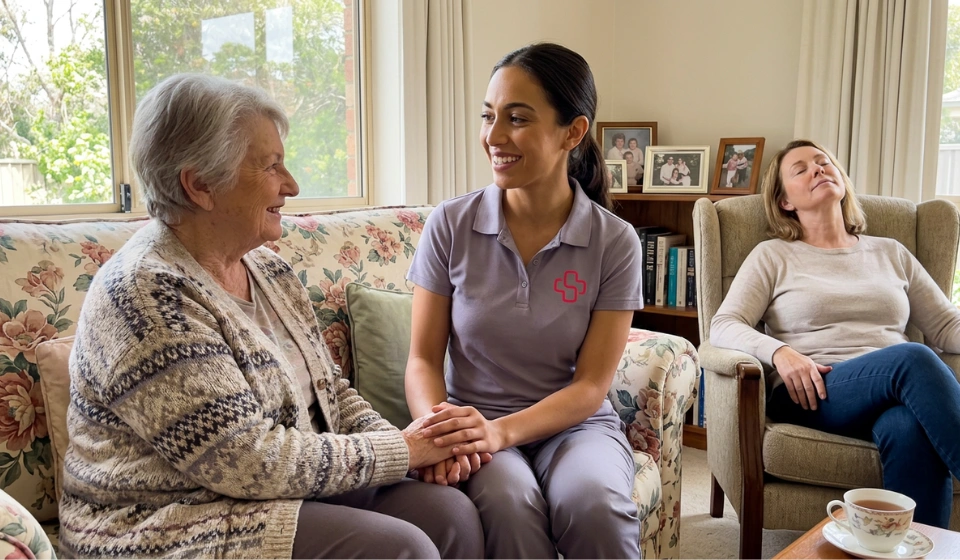
Rather than beginning with the care tasks, the coordinator arranged a first visit in which the support worker, accompanied by the eldest daughter, simply spent time with the client over coffee, speaking in Greek, asking about her life, her village and her family. The coordinator noted afterwards that this single visit changed the character of the entire arrangement, because for the first time since her hospital stay, the client had someone in her home to whom she did not have to explain herself.
Care That Respected Daily Rhythms & Food
The support worker prepared meals that reflected the client’s own cooking and preferences rather than generic meal assistance, and structured visits around the rhythms of her day rather than around a task-based schedule. Small details, such as how coffee was made, which dishes she wanted to keep making herself with assistance, and which days carried particular significance to her, were treated as part of the care rather than extras around it.
Personal Care Delivered With Understanding
Personal care, which had been a source of distress in earlier arrangements, became far more comfortable once the client could express her preferences, her worries and her sense of modesty directly in her own language. The support worker was able to explain each step, check on her comfort and respond to her reactions without relying on gesture or guesswork, which the client later described as the difference between being cared for and being handled.
A Quiet Safety Benefit Her Family Hadn't Anticipated
Because the client could now describe symptoms and discomfort clearly, the support worker was able to pass on accurate information to the family and, where appropriate, to her GP, rather than relying on vague observations. On one occasion, the client mentioned in passing that she had been feeling short of breath on the stairs, a detail she would almost certainly not have volunteered in English, and one that prompted a timely GP review.
Keeping The Family Informed & Included
The coordinator maintained regular, warm communication with the family, including the Melbourne-based sibling, ensuring that all three children had a clear and consistent picture of how their mother was doing. The eldest daughter in particular was encouraged to see the change in her mother as evidence that the family had made the right decision, rather than as a reflection of anything they had previously overlooked.
Outcomes And Impact
She Re-Engaged With Her Own Days
Within weeks of the new arrangement, the family noticed that their mother was answering the door again, joining conversations and showing interest in her own routines in a way she had not since her hospital admission. Her eldest daughter described the shift as seeing her mother come back into the room.
Her Care Became More Accurate & More Responsive
With a worker who could understand her fully, the client’s care needs were identified and addressed more precisely, from the foods she would and would not eat to the first hints of health concerns, reducing the guesswork that had characterised earlier arrangements and giving her GP better information to work with.
Her Appetite & Mood Improved
The family observed that their mother was eating more consistently and showing noticeably better spirits, changes her daughter attributed largely to having someone in the house with whom she could share ordinary conversation, humour and the small familiar rituals of the day.
Her Children's Guilt Eased
The two siblings living in Swan Hill, who had privately worried they had failed their mother, reported a genuine sense of relief at understanding what had gone wrong, and at seeing it put right. The eldest daughter said that simply having the problem named, and recognised as common among older migrants, lifted a weight she had not realised she was carrying.
Her Independence Was Protected
By restoring her ability to communicate and participate in her own care, the arrangement helped her remain confidently in her own home, supporting her family’s shared goal of avoiding any move into residential care while her wellbeing remained strong.
A Reflection From The Eldest Daughter
Some months into the arrangement, the client’s eldest daughter shared the following with the NurseLink Healthcare care coordinator:
She said that for a while after her mother came home from hospital, the family had told themselves she was simply tired, or perhaps sad, or perhaps just getting older, and that none of them had thought to ask whether she was lonely in a way that had nothing to do with being alone. She said the moment she walked in on her mother laughing in Greek at the kitchen table with her new support worker was one she would not forget, because she realised she had not heard that laugh in months. She said the practical help mattered, of course, but what had really changed was that her mother was being listened to again, in the language she thought and dreamed in, and that this seemed to have given something back to her that no amount of task-based care could have done on its own. She added that she wished more families knew to ask for this, because she had no idea, until it happened, how much of her mother’s quiet had been the effort of being understood.
Key Takeaways From This Case Study
Language loss in later life is common and often misread as withdrawal. Many older migrants lose fluency in their second language during illness or fatigue, and what looks like disengagement can simply be the effort of communicating in a language that has become hard to use.
Cultural and linguistic matching is a care quality issue, not a courtesy. Being able to express symptoms, preferences and discomfort directly improves the accuracy and safety of care, not just its warmth.
Familiar food, rhythms and conversation are part of care, not extras around it. Treating these details as central to the arrangement helped this client feel at home in her own home again.
Families often carry unspoken guilt about changes they could not have prevented. Acknowledging that what the family noticed was real and common helped ease a burden they had been carrying quietly.
A well-matched worker can surface health information a client would otherwise never share. A passing comment made in her own language led to a timely review that might otherwise have been missed.
Conclusion
A woman who had gradually stopped speaking to the people in her home found, through a care arrangement matched to her language and culture, that she had simply been waiting for someone she could talk to. For the family at the centre of this case study, NurseLink Healthcare provided not only reliable, well-organised homecare, but the recognition that being understood is part of what it means to be cared for.
She is laughing at her own kitchen table again. Her children no longer wonder what they missed. And a family in Swan Hill has learned that sometimes the most important thing a care plan can offer is a shared language.
If someone you love seems to be growing quieter at home, we encourage you to reach out to the NurseLink Healthcare team. We match care to the whole person, including the language and culture that make them who they are.
Latest Post
The Daughter Who Was Running Out Of Herself

The Help She Swore She’d Never Need
Carrying More Than He Could Carry
More Than Domestic Support
Still Her Home
The Weight She Was Carrying
Caring For Her Without Losing Himself
Managing Diabetes Without Sight
The Recovery Nobody Predicted
Finding Their Footing Again
On His Own Terms
When MS Moves In, The Whole Family Feels It
The Nurse Who Became The Patient
His Land, His Terms
Coming Home Differently
The Caregiver’s Pause
Still Going Home
Where He Belonged
Caring For Dad From Across The Country
Raising Three Kids While Living with Parkinson’s
A Family In Crisis. A Care Team Ready.
Homecare Cleaning Support
A Journey Of Comfort & Independence Through Homecare Support

Margaret’s Journey